Commodity Options Trading Basics: Calls, Puts, and Contract Specifications
By : Admin -
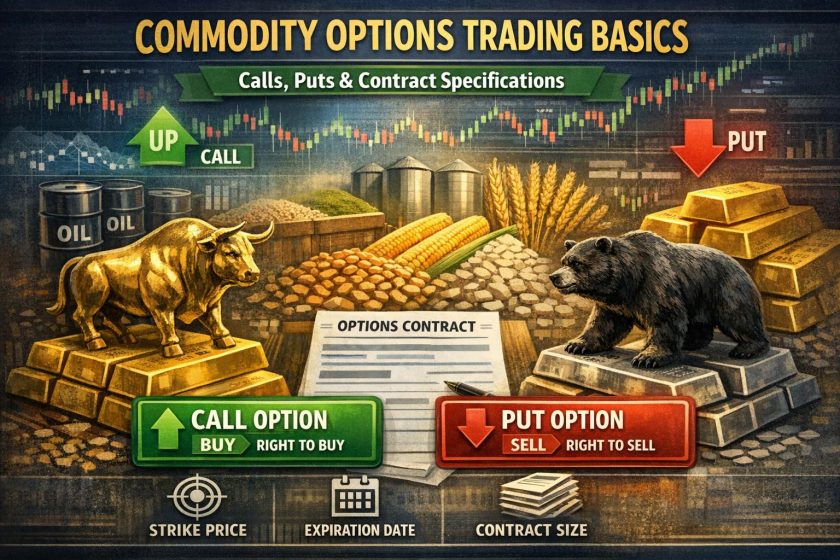
Introduction to Commodity Options Trading
Commodity options trading involves the use of calls and puts, which are derivative contracts that provide traders and investors with the ability to participate in price movements of physical commodities without necessarily owning the underlying asset. Commodities include energy products such as crude oil and natural gas, agricultural goods such as wheat and corn, and metals such as gold, silver, and copper. Options on these commodities are typically based on standardized futures contracts traded on organized exchanges.
Unlike outright futures positions, options provide asymmetric risk exposure. The buyer of an option pays a premium for the right, but not the obligation, to buy or sell the underlying commodity at a predetermined price within a defined time frame. This structure limits the buyer’s maximum loss to the premium paid, while preserving the potential for gains if the market moves favorably. Sellers, also known as writers, assume the obligation associated with the contract and receive the premium in exchange.
Understanding the mechanics of calls and puts, along with the specifications of commodity contracts, is essential before participating in this segment of the financial markets. Commodity options combine elements of physical market fundamentals and financial derivatives pricing, requiring awareness of both.
Understanding Calls and Puts
In the context of commodity markets, a call option gives the holder the right, but not the obligation, to buy a specified commodity futures contract at a predetermined strike price before or at expiration. A put option grants the right, but not the obligation, to sell a commodity futures contract at the strike price within the same constraints.
Both instruments derive their value from the price of the underlying futures contract rather than the physical commodity itself. When traders buy commodity options, they are typically gaining exposure to futures price movements, not arranging immediate delivery of physical goods. This distinction streamlines trading and aligns options pricing with futures market dynamics.
The buyer of an option pays a premium upfront. This premium reflects several components, including intrinsic value, time value, market volatility, and prevailing interest rates. The seller receives the premium and takes on the potential obligation to fulfill the contract if exercised.
Call Options
Call options are generally used when a trader anticipates an increase in the price of the underlying commodity futures contract. If the futures price rises above the strike price plus the premium paid, the call option becomes profitable for the buyer. The intrinsic value of a call option is the amount by which the futures price exceeds the strike price.
For example, if a crude oil call option has a strike price of 70 and the futures price increases to 75, the option has intrinsic value of 5, excluding the premium paid. If the premium was 2, the net gain would be 3, assuming the position is closed at that level. If the price remains below the strike price at expiration, the call expires worthless and the buyer’s loss is limited to the premium.
Call options are used not only for speculation but also for hedging. An airline concerned about rising fuel prices may purchase call options on crude oil futures to limit exposure to higher costs while retaining the benefit if prices decline.
Put Options
Put options are typically used when a trader expects the underlying commodity price to decline. If the futures price falls below the strike price, the put gains intrinsic value. The value equals the difference between the strike price and the current futures price.
For instance, if a wheat put option has a strike price of 600 cents per bushel and the futures price drops to 550, the intrinsic value is 50 cents. After accounting for the premium paid, the trader can determine the net outcome. If prices remain above the strike price at expiration, the put expires worthless, and the loss is limited to the premium.
Producers frequently use put options to hedge downside risk. A farmer concerned about falling crop prices may purchase puts to establish a minimum selling price, thereby protecting anticipated revenue without committing to deliver at a fixed futures price.
Pricing Components of Commodity Options
The price of a commodity option, known as the premium, consists of intrinsic value and time value. Intrinsic value exists when the option is in the money, meaning it would have value if exercised immediately. Time value reflects the probability that the option could gain intrinsic value before expiration.
Several factors influence the premium. The relationship between the current futures price and the strike price plays a central role. Volatility is another major determinant. Higher expected volatility increases option premiums because it raises the likelihood of significant price movements. Time to expiration also affects value; longer durations typically result in higher premiums due to the extended opportunity for favorable price changes.
Interest rates and storage costs may also contribute, particularly for commodities with significant carrying costs. These inputs are integrated into widely used pricing models that estimate fair value under prevailing market conditions.
Contract Specifications
Commodity options are standardized contracts traded on regulated exchanges. Each exchange defines specific terms that govern trading, settlement, and delivery procedures. These contract specifications ensure uniformity and transparency in the marketplace.
While specifications differ across commodities, the fundamental components are broadly similar. Traders must review them carefully to understand the obligations and characteristics of each contract.
Contract Size
Each commodity option corresponds to a particular futures contract with a defined contract size. For example, a gold futures contract may represent 100 troy ounces, while a crude oil futures contract may represent 1,000 barrels. Agricultural contracts have their own standard quantities measured in bushels or metric tons.
The contract size determines the notional exposure of the trade. A relatively small price movement in the underlying commodity can translate into substantial gains or losses due to the scale of the contract. Traders should assess whether the contract size aligns with their capital resources and risk tolerance.
Expiration Date
Every commodity option has an expiration date, beyond which the contract ceases to exist. On or before this date, the holder may exercise the option if it is eligible for exercise under the contract’s style. After expiration, in-the-money options may be automatically exercised depending on exchange rules, while out-of-the-money options expire without value.
Time decay, also referred to as theta, describes the reduction in an option’s time value as expiration approaches. This decay accelerates in the final weeks of the contract’s life. Traders must monitor the remaining time carefully, as holding an option without favorable price movement can result in gradual erosion of its premium.
Strike Price
The strike price is the predetermined price at which the underlying futures contract can be bought or sold. Exchanges list multiple strike prices for each expiration month, typically arranged at regular intervals above and below the current futures price.
Selecting an appropriate strike price involves balancing probability and cost. Options with strike prices close to the futures price tend to have higher premiums because they have a greater likelihood of finishing in the money. Options further away from the current price are less expensive but carry lower probabilities of profitability.
Settlement Method
Commodity options may be settled either through physical delivery of the underlying futures contract or through cash settlement. In most cases, exercising an option results in the creation of a corresponding futures position rather than immediate delivery of the physical commodity. The holder must then manage or offset that futures position prior to its expiration to avoid delivery obligations.
Understanding the settlement process is important to prevent unintended positions. Many traders choose to close option positions before expiration instead of exercising them.
Styles of Exercise
Commodity options can be structured as American-style or European-style. American-style options may be exercised at any time up to and including the expiration date. European-style options can only be exercised on the expiration date itself.
The style affects strategic flexibility. American-style options provide greater discretion, which can increase their value relative to otherwise similar European-style contracts. However, in practice, many option holders choose to offset positions in the secondary market rather than exercise them.
Market Drivers of Commodity Option Values
The value of commodity options is sensitive to a range of market forces beyond simple price direction. Supply and demand dynamics in the physical commodity market play a central role. Weather patterns influence agricultural outputs, geopolitical developments affect energy supplies, and industrial demand shapes metal prices.
Macroeconomic indicators such as inflation rates, currency movements, and global economic growth can also drive commodity prices. For example, a strengthening domestic currency may pressure export-oriented commodities, while rising inflation expectations may support precious metal prices.
Seasonality is another factor, particularly in agricultural markets. Planting and harvest cycles introduce predictable variations in supply expectations, which in turn affect volatility and option premiums.
Implied volatility, derived from current option prices, reflects market expectations of future price fluctuations. A rise in implied volatility can increase option premiums even if the underlying futures price remains unchanged.
Speculation and Hedging Applications
Commodity options serve two primary purposes: speculation and hedging. Speculators seek to profit from anticipated price movements while controlling risk through limited premium exposure. Options allow them to establish directional positions with defined downside.
Hedgers use options to manage operational risks associated with commodity price fluctuations. Producers, processors, and consumers can structure option positions to protect margins or stabilize input costs. For instance, a mining company may purchase puts to secure a minimum sale price for extracted metals, while a food manufacturer might buy calls to guard against rising grain costs.
Options can also be combined into more complex strategies involving multiple strike prices or expiration dates. These strategies are designed to tailor risk and reward profiles to specific market views.
Risk Management Considerations
Although options limit the maximum loss for buyers to the premium paid, risk remains significant. A purchaser may lose the entire premium if the option expires out of the money. Sellers face potentially substantial losses if the market moves sharply against their position, particularly when writing uncovered options.
Liquidity is an additional consideration. Some commodity options have lower trading volumes, which can lead to wider bid-ask spreads and increased transaction costs. Slippage may affect realized returns.
Prudent traders assess position size relative to account equity and maintain margin reserves when required. Sellers of options are typically required to post margin to cover potential obligations. Exchanges and clearinghouses establish these requirements to maintain market stability.
Conclusion
Commodity options trading represents a structured method of participating in commodity price movements while managing exposure to risk. By understanding the mechanics of calls and puts, the significance of contract specifications, and the factors that influence option premiums, traders can approach this market with greater clarity.
These instruments integrate the economic realities of commodity supply and demand with financial pricing models and standardized exchange procedures. Whether used for speculation or hedging, commodity options require careful analysis of market conditions, volatility expectations, and contract terms. With disciplined risk management and a thorough grasp of their structural components, commodity options can form a defined part of a broader trading or risk mitigation framework.
This article was last updated on: March 2, 2026