Commodity Options vs. Commodity Futures: Risk and Capital Differences
By : Admin -
Introduction
Commodity trading plays a central role in global financial markets, connecting producers, consumers, and investors through standardized contracts tied to physical goods such as oil, natural gas, gold, wheat, or copper. Among the primary instruments available for participating in these markets are commodity options and commodity futures. Although both derive their value from underlying commodities and are frequently traded on regulated exchanges, they differ significantly in structure, obligations, risk exposure, and capital requirements.
Market participants use these instruments for a variety of purposes. Commercial users often engage in them to hedge against adverse price movements, while speculators seek to profit from anticipated shifts in supply and demand. Institutional investors may employ them for portfolio diversification or tactical allocation. Despite their shared foundation in commodity pricing, options and futures operate under distinct contractual principles. Understanding these differences is essential for evaluating their suitability within an investment or risk management framework.
Understanding Commodity Options
A commodity option is a derivative contract that grants the holder the right, but not the obligation, to buy or sell a specific commodity at a predetermined price, known as the strike price, on or before a defined expiration date. These contracts are standardized in terms of contract size and expiration cycles, and they are often based on underlying commodity futures rather than the physical asset itself.
Options are categorized into call options and put options. A call option provides the holder with the right to purchase the underlying commodity at the strike price. A put option grants the right to sell the commodity at the strike price. The buyer pays a fee, known as the premium, to acquire this right. The seller, often referred to as the writer, receives the premium in exchange for assuming the contractual obligation if the buyer exercises the option.
The value of a commodity option is influenced by several factors, including the current market price of the underlying commodity, the strike price, the time remaining until expiration, implied volatility, interest rates, and overall market conditions. The relationship between these variables determines whether the option is in the money, at the money, or out of the money, which affects its intrinsic and time value.
Risk in Commodity Options
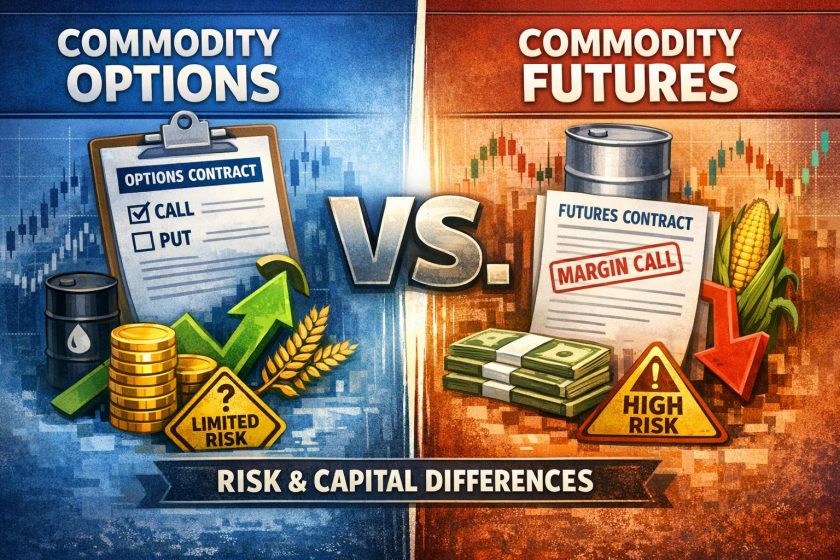
One of the defining characteristics of commodity options for buyers is limited downside risk. The maximum potential loss is confined to the premium paid at the time of purchase. If market conditions move unfavorably and the option expires without value, the buyer is not obligated to proceed with the transaction. This feature introduces a known and predefined risk level at the outset of the trade.
For example, if an investor purchases a call option on crude oil futures and oil prices decline, the option may lose value or expire worthless. However, the investor will not be required to purchase the underlying futures contract. The loss is limited to the premium paid for the option and any transaction costs incurred.
In contrast, sellers of commodity options face substantially greater risk. A seller of a call option may encounter significant losses if the underlying commodity price rises sharply above the strike price. Similarly, a seller of a put option can incur losses if the market price falls far below the strike price. In both cases, the premium received provides only partial protection against potentially large adverse price movements. As a result, option writing requires careful margin management and a strong understanding of price dynamics.
Capital Requirements for Commodity Options
The capital outlay for purchasing commodity options is generally limited to the premium and applicable brokerage fees. Compared to entering a futures contract, this initial expenditure is typically smaller, making options accessible to traders seeking defined exposure with constrained capital commitment.
However, although the upfront cost is lower, option buyers must account for the effect of time decay. As expiration approaches, the time value component of an option diminishes, which can erode the premium even if the underlying commodity price remains relatively stable. This means that an investor may incur losses not only from adverse price movements but also from insufficient movement within the specified time frame.
Option writers are subject to substantially higher capital requirements. Exchanges and brokerage firms require margin deposits to ensure that the seller can meet potential obligations. Depending on volatility and market conditions, these margin requirements may fluctuate, increasing the capital necessary to maintain open positions.
Strategic Applications of Commodity Options
Commodity options are frequently used in structured strategies that combine calls and puts to achieve specific risk-return objectives. Producers of agricultural commodities may purchase put options to establish a minimum selling price, thereby protecting revenue against declines. Conversely, consumers of raw materials may use call options to secure maximum purchase prices while retaining the ability to benefit from price decreases.
Speculators might employ options to express directional views with limited capital exposure. Because options provide leverage, small percentage changes in the underlying commodity price can produce larger percentage changes in option value. This leverage can enhance gains but also increases the probability of rapid premium erosion if the market fails to move as anticipated.
Exploring Commodity Futures
Commodity futures are standardized agreements between two parties to buy or sell a specified quantity of a commodity at a predetermined price on a set future date. These contracts are traded on organized exchanges and are marked to market daily. Unlike options, futures contracts impose a binding obligation on both the buyer and the seller to fulfill the contract terms at expiration, unless the position is closed prior to that date.
In practice, most futures contracts are offset before delivery occurs. Traders typically close positions by entering an opposite transaction, thereby eliminating the obligation to make or take physical delivery. Nevertheless, the contractual structure assumes full commitment from both parties, which significantly affects risk exposure.
Futures prices reflect expectations about future supply and demand, storage costs, interest rates, and transportation expenses. Market participants analyze macroeconomic indicators, geopolitical developments, seasonal patterns, and inventory data to inform trading decisions. Because of the standardized and transparent nature of futures exchanges, these instruments play a central role in price discovery for global commodity markets.
Risk in Commodity Futures
Futures contracts carry substantial financial risk due to their symmetric obligation structure. When a trader enters into a futures contract, gains and losses are determined by daily price fluctuations. If the market moves unfavorably, the trader may be required to deposit additional funds to maintain the position.
This process, known as marking to market, ensures that losses are realized incrementally rather than accumulated until expiration. Brokerage firms require traders to maintain an initial margin and a maintenance margin. If account equity falls below the maintenance level due to adverse price movements, a margin call is issued, requiring the trader to provide additional capital promptly.
The potential for loss in a futures position is theoretically unlimited, as commodity prices can move significantly in response to economic or geopolitical events. A trader holding a long futures contract in natural gas, for instance, could sustain large losses if supply increases unexpectedly or demand decreases due to mild weather conditions. Similarly, a short position is exposed to price spikes resulting from production disruptions or policy shifts.
Capital Requirements for Commodity Futures
Although margin requirements generally represent only a fraction of the contract’s full notional value, they often exceed the premium required to purchase an option. The initial margin functions as a performance bond rather than a down payment. Because futures are leveraged instruments, a relatively small margin deposit controls a substantial underlying value.
This leverage amplifies both gains and losses. A modest percentage change in the commodity price can translate into a significant percentage change relative to the margin posted. Consequently, effective capital management is critical. Traders must maintain sufficient liquidity to withstand market volatility without being forced to liquidate positions at unfavorable prices.
In periods of heightened market turbulence, exchanges may increase margin requirements to mitigate systemic risk. Such adjustments can raise the capital necessary to sustain open positions, affecting both speculative traders and commercial hedgers.
Hedging and Speculation with Futures
Futures contracts are widely used for hedging operational risk. An airline company may purchase futures contracts on jet fuel to stabilize future fuel costs. A mining company may sell futures contracts to secure a future selling price for its output. In both cases, the objective is to reduce uncertainty in cash flows by offsetting price exposure in the physical market.
Speculators, in contrast, assume price risk in pursuit of profit. They provide liquidity to the market, facilitating the transfer of risk from commercial entities. Because futures require active risk management and responsiveness to margin calls, speculative trading demands careful monitoring and disciplined capital allocation.
Comparative Analysis of Risk Profiles
The principal distinction between commodity options and commodity futures lies in the asymmetry of risk. Option buyers face limited downside risk and potentially substantial upside, whereas futures traders encounter symmetrical risk, with both gains and losses determined by the magnitude of price movements.
Options introduce additional dimensions of risk related to volatility and time decay. The sensitivity of an option’s price to changes in volatility, time to expiration, and underlying price movement can produce complex payoff profiles. Futures contracts, by comparison, respond directly and proportionally to shifts in the underlying commodity price.
From a risk management perspective, options can function as insurance-like instruments, offering price protection without eliminating participation in favorable movements. Futures, on the other hand, lock in prices and eliminate uncertainty but require tolerance for interim price variability and margin adjustments.
Liquidity and Market Considerations
Both commodity options and futures are traded on established exchanges with centralized clearing mechanisms. However, liquidity levels can vary depending on the specific commodity and contract expiration. Major commodities such as crude oil, gold, and corn generally exhibit high trading volumes, resulting in narrower bid-ask spreads and more efficient price execution.
Options markets may display wider spreads, particularly for contracts that are deeply out of the money or near expiration. This factor can influence transaction costs and impact overall profitability. Market participants must consider liquidity conditions when selecting instruments and strike prices.
Regulatory and Operational Framework
Commodity derivatives trading is subject to regulatory oversight designed to ensure market integrity and financial stability. Clearinghouses act as central counterparties, reducing counterparty risk by guaranteeing contract performance. Margin requirements, position limits, and reporting obligations contribute to a structured trading environment.
Operational considerations also differ between options and futures. Options involve additional analytical components, including implied volatility assessments and pricing models. Futures trading requires ongoing monitoring of account equity and maintenance of adequate funding to satisfy margin demands.
Conclusion
Commodity options and commodity futures represent two foundational instruments in the commodities marketplace. While both provide exposure to price movements in physical goods, they differ in contractual obligation, capital commitment, and exposure to risk. Options grant the right without requiring execution, limiting the buyer’s potential loss to the premium paid. Futures impose binding obligations on both parties, creating symmetrical and potentially unlimited profit and loss dynamics.
The selection between these instruments depends on individual risk tolerance, financial capacity, and strategic objectives. Investors seeking predefined downside exposure may find options suitable, whereas those aiming to hedge or speculate with direct and proportional market exposure may consider futures. In all cases, thorough analysis, disciplined capital management, and a clear understanding of contract mechanics are essential for effective participation in commodity markets.
This article was last updated on: March 22, 2026