Why investing can be better than binary options
Binary options are a fixed payout bet on a specific outcome by a specific time. You’re not buying the underlying asset; you’re buying a contract that settles based on a yes/no condition. In the “classic” format, the contract settles at a fixed amount if the condition is true and at zero if it’s false. Many retail platforms dress it up with different names, but the core idea stays the same.
Investing is different. Investing is generally about owning assets expected to produce long-run returns through cash flows, reinvestment, growth, and compounding. The timeline is longer, the return drivers are broader, and you don’t need to be right at a specific minute on a specific day to get paid.
The reason investing is often a better default option isn’t because binaries are automatically “bad” or because investing is automatically “safe.” It’s because the structure of most retail binary products combines three features that are hard to beat at the same time: capped upside, time pressure, and pricing set by a dealer with embedded margin. If you don’t have a real edge in probability estimation and execution, those features tend to push your expected results negative, even if you occasionally rack up impressive win streaks.
This articles assumes that you have basic knowledge about investing and investments. If you do not then I recommend that you visit Investing.co.uk before you read the rest of this article.
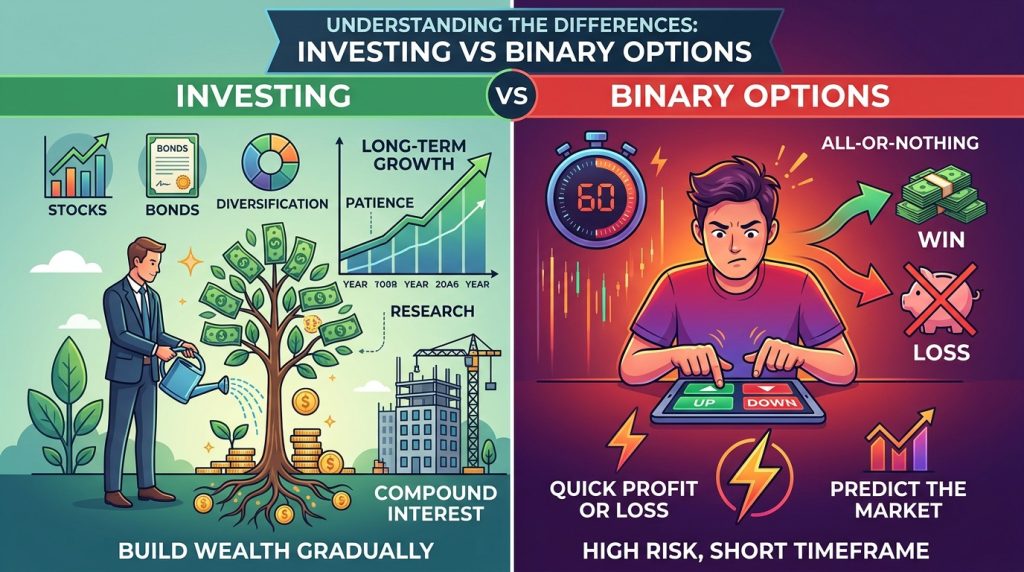
Payoff structure and expectancy
Investing usually gives you uncapped upside; binaries usually don’t
In most investing, upside is not capped in a strict mechanical way. A stock can compound for years, a business can expand margins, dividends can be reinvested, and you can hold through multiple cycles. Even if you use funds or ETFs, you are still exposed to the long-run drift of productive assets.
Binary options flip that profile. Your payoff is capped by contract design. If the statement is true, you get a defined payout. If it’s false, you lose your stake. The market can move massively in your favor, and you still only collect the fixed result. This is why binaries can feel frustrating even when you’re “very right.” The contract doesn’t pay you for being very right, it pays you for being right on the finish line.
Some platforms explain this format explicitly using the “priced 0 to 100” style for their digital/binary contracts, with settlement at 0 or 100 depending on whether the statement is true. IG’s Digital 100 materials describe exactly that settlement concept and that the contract is priced between 0 and 100.
The contract price is a probability, not just a direction
Here’s the part most retail traders don’t fully internalize. With binaries and binary-style “digitals”, you are buying a probability at a quoted price. If a contract costs 65, you’re effectively paying 65 for a chance to receive 100 at expiry (in the standard settle-at-100 format). Whether that’s a good deal depends on whether the true probability of finishing in-the-money is higher than what the price implies, after accounting for the dealer’s margin and friction.
It’s easy to think “I’m bullish on EUR/USD, so buy.” But that’s not enough. You need “I’m bullish and the price I’m paying underestimates how likely this is.” Without that second part, you’re not trading value, you’re buying a timed directional lottery ticket with a cap on winnings.
Platforms are open about the inputs they use to set these prices. IG states its digital prices are “set by our dealing desk” and based on factors including time to expiry, current value of the underlying market, expected future volatility, and supply and demand.
That one sentence explains why many binary traders lose money while still feeling like they “read the direction right” a lot. They are competing against a probability quote that already reflects market level, time, and volatility expectations, plus dealer margin.
The expectancy problem: you need to be right more than you think
In investing, your expected return comes from a long-run premium for taking risk in productive assets, plus whatever skill you add through allocation and security selection. You can be “a bit early” and still win over time. You can be “roughly right” on a business and still get paid if the business compounds.
In binaries, you need to be right on a deadline. And your payouts are structured so that small pricing disadvantages matter a lot because no single trade can pay you an outsize return to compensate. If you repeatedly take slightly bad prices, your results can be reliably negative even with a decent hit rate.
This isn’t a moral judgment; it’s basic payoff geometry. Capped wins plus uncapped repetition of friction equals a strategy that needs unusually clean edge to survive. Many retail traders don’t have that edge, and worse, the product design encourages them to trade more often, which multiplies the effect of small disadvantages.
Time horizon and signal quality
Short expiries amplify noise and reduce the value of “being right”
Binary options are often marketed with short expiries. Short expiries are attractive because they provide quick feedback and the illusion of productivity. But markets, especially FX and indices, are noisy in the short run. Order flow, liquidity gaps, headlines, and random churn can dominate price over minutes. The shorter the expiry, the more your outcome becomes a timing game rather than a directional thesis.
That timing dependence is not just “hard.” It’s mathematically unfriendly. You can have a correct medium-term view and still lose repeatedly because the move didn’t happen before expiry. The price can move in your direction right after expiry, which is a common experience for binary traders. It feels like bad luck, but it’s actually the contract design doing its job: forcing an outcome on a schedule.
Investing benefits from the opposite effect. Time is usually on the investor’s side if they hold productive assets and reinvest. The investor does not need the market to agree by 3:00pm. They need the underlying value creation to show up over years.
Binary outcomes create cliff risk around the strike
Binary settlement creates cliff risk. One tick can be the difference between a full win and a full loss. That cliff effect increases outcome variance and makes it harder to manage trades rationally. In a normal position trade, you can scale out, adjust stops, or reduce exposure. In a typical binary bet, you either get the payout or you don’t.
Even when a platform allows early close, the pricing around the strike near expiry can whip around as probability compresses into certainty. Small moves in the underlying can cause big changes in contract value. Traders who treat this like “just another chart trade” are often shocked by how quickly P&L swings.
Investing, again, has volatility, but it rarely has this forced all-or-nothing cliff tied to a single timestamp. That difference alone makes investing more forgiving for most people.
Costs, dealing, and “edge”
Friction is harsher when upside is capped
Trading costs matter everywhere, but they matter more when your upside is capped and your average win size is limited. If you pay a slightly worse price than fair value on each binary bet, you can’t “make it back” with one massive winner because massive winners aren’t in the product’s design.
Dealer-priced products also embed margin in a way that can be hard to see. IG’s own explanation that digital prices are set by its dealing desk, and influenced by volatility and supply/demand, is a direct signal that you’re not trading a neutral exchange price.
That doesn’t automatically mean manipulation. It means there is a professional pricing party on the other side whose job is to run a book profitably. If you don’t have an information advantage, a model advantage, or a behavioral discipline advantage, you’re playing a game where the default expectation is not in your favor.
Investing can be made cheap and mechanically efficient
The cost picture for investing can be extremely favorable today. Broad index funds and ETFs can be accessed with low fees in many jurisdictions. Turnover can be low. The investor can decide to do almost nothing for long periods. That’s not laziness; that’s cost control.
Even active investing, when done with a longer holding period, tends to suffer less from spread and execution slippage because it trades less. The investor’s friction is often dominated by decisions (buying the wrong thing, holding through thesis breaks) rather than by transaction mechanics on every trade.
Binary-style products typically push you toward higher turnover, which makes friction compound faster against you.
Risk of ruin and behaviour
The real risk is not “one trade”; it’s the path of many trades
Binary options are often marketed as limited risk because your maximum loss is known upfront. That is true per trade. But portfolio risk is about sequences, not single events. A strategy with slightly negative expectancy and high frequency can quietly grind an account down. The trader sees lots of wins, feels skilled, then a cluster of losses wipes out weeks of progress.
This happens because binary outcomes create a sharp distribution: many smallish wins, occasional full losses, with timing risk and pricing disadvantage in the background. If the trader increases stake size after wins, chases losses, or trades too frequently, the account becomes fragile.
Investing has drawdowns, sometimes deep ones, but diversified investing typically reduces the risk of sudden account death because the exposure is spread across assets and time. Investors can still blow up by using leverage, concentrating wildly, or panic selling at bottoms, but the base activity doesn’t push you toward “more trades, more dopamine, more damage” in the same way.
Fast feedback loops encourage overtrading
Binaries give immediate outcomes. That quick win or quick loss is addictive in a mechanical sense. It pulls you into repeating the behavior. The platform experience is often built around that loop. Even disciplined people can drift into overtrading because the product makes it feel like there’s always another “setup.”
Investing reduces the number of decisions you must make. Fewer decisions means fewer chances to sabotage yourself. For most individuals, that’s not a small edge, it’s the edge.
Timing products reward the wrong kind of confidence
Many binary traders confuse confidence with probability edge. A strong feeling about direction is not the same as a priced edge. Because the contract’s price reflects probability, you must be better than the dealer at judging the probability relative to the quoted price. Most retail traders are not doing that work. They are converting chart signals into yes/no bets without a probability model.
Investing can still be done badly, but the return mechanism is not as dependent on you beating a dealer’s short-term probability quote over and over. It is more about being exposed to long-run returns while avoiding catastrophic mistakes.
Regulation and consumer outcomes
One of the clearest external signals about binary options is regulatory action. Multiple major regulators have concluded that binaries create significant consumer harm in the retail market.
In the United Kingdom, the Financial Conduct Authority confirmed a permanent ban on the sale, marketing, and distribution of binary options to retail consumers. The rule took effect in April 2019, effectively removing the product from the UK retail market.
Across the European Union, the European Securities and Markets Authority adopted decisions prohibiting the marketing, distribution, or sale of binary options to retail clients. This included the 2018 product intervention decision under EU law and several renewals while national regulators implemented their own long-term restrictions.
In Australia, the Australian Securities and Investments Commission introduced a product intervention order banning the issue and distribution of binary options to retail clients. The regulator concluded the products had caused, or were likely to cause, substantial harm to retail traders. The ban came into force in May 2021.
Regulators don’t ban products because they dislike speculation. They intervene when the observed outcomes and selling practices produce consistent harm, especially when retail clients misunderstand the odds. You can treat that as a warning label. It doesn’t prove every binary trade is wrong, but it does say: the base case for most retail people has been ugly often enough to justify hard restrictions.
Investing, of course, is also regulated and can also be mis-sold, but broad investing products are generally structured around long-run wealth building rather than short-horizon yes/no outcomes with dealer-set odds.
Where binaries can have a place
Binary options can make sense in narrow cases where a trader has a specific event view, wants defined risk, and can judge probability versus price better than the quote they’re offered. That usually requires more than chart confidence; it requires disciplined sizing, a real pricing framework, and the ability to trade selectively.
For most people trying to build wealth, investing is usually the better option because it aligns with compounding, reduces forced timing pressure, and avoids the repeated probability-pricing battle that binary products often impose.
This article was last updated on: March 5, 2026