How Option Premiums Are Priced in Commodity Markets
By : Admin -
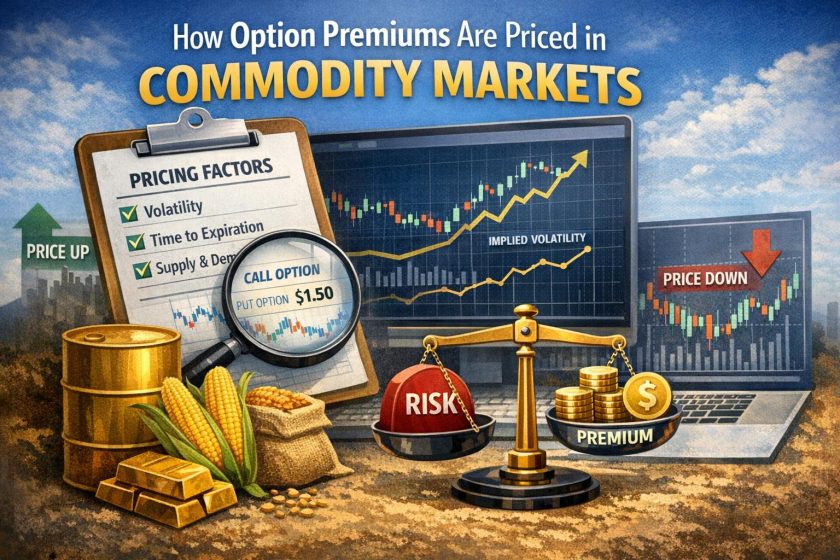
Understanding Option Premiums in Commodity Markets
In the commodity markets, options are financial instruments that provide the holder the right, but not the obligation, to buy or sell a commodity at a predetermined price before or on a specified date. The cost of acquiring this right is referred to as the option premium. Understanding how these premiums are priced is fundamental for traders, hedgers, producers, and investors who seek to manage risk or capitalize on commodity price movements.
Commodity options differ in important ways from equity options because the underlying assets include physical goods such as crude oil, natural gas, gold, wheat, coffee, and industrial metals. These markets are influenced by supply and demand dynamics, seasonal patterns, geopolitical developments, storage costs, and transportation constraints. As a result, option premiums in commodity markets reflect not only financial variables but also characteristics that are specific to physical assets.
Basic Structure of Commodity Options
Commodity options are commonly written on futures contracts rather than directly on the physical commodity itself. When a trader buys an option on crude oil, for example, the underlying asset is typically a crude oil futures contract traded on an exchange. This structure connects the option premium closely to the futures price, not the spot price of the commodity, although the two are related.
A call option grants the right to buy the underlying futures contract at a specified strike price, while a put option grants the right to sell it at that strike price. The buyer of the option pays the premium upfront, and the seller, also referred to as the writer, collects it in exchange for assuming the potential obligation embedded in the contract.
The premium is quoted in terms specific to the commodity. For instance, in energy markets it may be quoted in dollars per barrel, while in agricultural commodities it may be quoted in cents per bushel. The quoted premium, when multiplied by the contract size, determines the total dollar value of the transaction.
Components of Option Premiums
Option premiums in commodity markets consist of two primary components: intrinsic value and time value. These elements work together to form the total premium price and provide a framework for understanding how market participants assess an option’s worth.
Intrinsic Value
The intrinsic value of an option represents the immediate economic benefit of exercising the option at the current market price. For a call option, intrinsic value is calculated as the futures price minus the strike price. For a put option, it is the strike price minus the futures price. If this calculation produces a negative result, the intrinsic value is defined as zero because rational traders would not exercise an option at a loss.
An option with positive intrinsic value is described as in the money. If the futures price and the strike price are equal, the option is at the money, and its intrinsic value is zero. When the intrinsic value is zero because exercise would not be beneficial, the option is considered out of the money.
In commodity markets, intrinsic value can shift rapidly. For example, weather forecasts may alter expectations for crop yields, causing grain futures prices to adjust sharply. These shifts immediately affect the intrinsic value of related options. Intrinsic value therefore reflects current market conditions without considering the uncertainty of future movements.
Time Value
The time value of an option is the portion of the premium that exceeds intrinsic value. It represents the compensation sellers require for bearing uncertainty during the remaining life of the contract. Time value captures the possibility that the option may move into the money before expiration.
Even an out-of-the-money option can command a significant premium if there is sufficient time until expiration and the underlying commodity exhibits price variability. In markets such as natural gas or crude oil, where price swings can be substantial over short periods, time value plays a particularly important role.
Time value declines as expiration approaches, a process often referred to as time decay. The erosion of time value is not linear; it generally accelerates in the final weeks before expiration. For traders managing short positions in options, time decay can be a central source of potential profit. For option buyers, however, time decay represents a cost that must be offset by favorable price movement in the underlying commodity.
Determinants of Option Premiums
Beyond intrinsic and time value, several external and market-based factors determine the level of option premiums in commodity markets. These factors interact continuously and can cause premiums to fluctuate even when the underlying futures price remains relatively stable.
Volatility
Market volatility is one of the most influential determinants of option premiums. Volatility measures the extent of expected price fluctuations in the underlying futures contract. Higher volatility implies a broader range of potential future prices and increases the probability that an option will expire in the money.
In commodity markets, volatility may arise from geopolitical developments, weather events, production decisions by major exporting countries, or unanticipated disruptions in transportation and refining capacity. As volatility rises, the time value component of premiums increases because sellers demand greater compensation for assuming uncertainty. Conversely, when markets are stable and price movements are restrained, premiums tend to decline.
Volatility embedded in option prices is referred to as implied volatility. Traders often compare implied volatility with historical volatility to evaluate whether options appear relatively expensive or inexpensive in relation to past price behavior.
Time to Expiration
The time left until expiration directly affects the time value of an option. Longer-dated options provide more opportunity for favorable price movements and therefore command higher premiums. In commodities with strong seasonal patterns, such as agricultural products, the length of time to expiration may intersect with planting or harvest cycles, influencing expectations about volatility during specific months.
Short-dated options are more sensitive to immediate market developments, while long-dated options reflect broader expectations about supply, demand, and macroeconomic conditions. The relationship between time and premium is shaped by the declining probability of substantial price changes as expiration approaches.
Interest Rates
Interest rates influence commodity option pricing because they affect the cost of carrying positions and the relationship between spot and futures prices. When interest rates rise, the cost of holding inventory increases, which can affect futures prices and, indirectly, option premiums.
In pricing models, higher interest rates generally increase call option premiums and reduce put option premiums, assuming other variables remain constant. This adjustment reflects the present value of future cash flows and the opportunity cost of capital tied up in positions.
Supply and Demand for Options
Apart from theoretical inputs, actual trading activity plays a role in determining premiums. If producers heavily demand put options to hedge against falling prices, premiums for those puts may rise due to order flow imbalances. Similarly, increased speculative interest in calls can elevate call premiums beyond levels suggested by models alone.
Commodity markets often see concentrated hedging demand from specific groups, such as airlines seeking to hedge fuel costs or mining companies hedging metal production. The aggregate behavior of these participants influences liquidity and pricing dynamics.
Storage Costs and Convenience Yield
Physical commodities incur storage and insurance costs. These costs affect futures pricing and therefore influence option premiums. Certain commodities also provide a non-monetary benefit to holders known as convenience yield, which reflects the operational advantage of having immediate access to the physical good.
For example, a refinery holding crude oil inventories may benefit from production flexibility. These considerations influence futures curves and shape the intrinsic value and expected distribution of future prices, thereby affecting premiums.
Option Pricing Models in Commodity Markets
To evaluate and compare premiums, market participants rely on quantitative pricing models. While no model perfectly captures all real-world influences, these frameworks provide consistent methods for estimating theoretical value.
Black-Scholes Model
The Black-Scholes model was originally developed for pricing European-style stock options. It assumes constant volatility, a risk-free interest rate, and lognormally distributed price movements. In commodity markets, a modified version known as the Black model is frequently applied to futures options rather than spot-based instruments.
Under this framework, inputs include the current futures price, strike price, time to expiration, interest rate, and volatility. The model produces a theoretical premium and associated sensitivity measures. Although actual market conditions may diverge from assumptions, the model remains widely used due to its analytical clarity and computational efficiency.
Binomial Option Pricing Model
The Binomial option pricing model offers a more flexible approach. It constructs a price tree that represents possible paths the underlying futures contract may take over discrete time intervals. At each node, the price can move upward or downward by specified factors.
This structure allows for varying volatility assumptions and can incorporate features such as early exercise, which is relevant for American-style options commonly found in commodity markets. By working backward from expiration to the present, the binomial model calculates the current theoretical premium.
Implied Parameters and Market Calibration
In practice, traders often reverse-engineer models to extract implied volatility from observed market prices. Rather than treating volatility as a fixed input, they adjust it until the model output matches the traded premium. This process creates a volatility surface that varies across strike prices and expiration dates.
Commodity options frequently display volatility skew, where implied volatility differs depending on whether an option is in the money or out of the money. This skew reflects market perceptions of asymmetric risks, such as supply shocks that may cause abrupt upward price movements in energy markets.
Risk Sensitivities and Premium Behavior
Option premiums are highly responsive to changes in underlying variables. Traders use sensitivity measures, commonly known as the Greeks, to quantify how premiums react to shifts in price, volatility, time, and interest rates.
Delta measures the rate of change of the option premium relative to changes in the underlying futures price. Theta captures time decay, representing the change in premium as time passes. Vega indicates sensitivity to changes in implied volatility. These measures are particularly important in commodity markets where rapid adjustments in market conditions can alter option valuations significantly within short periods.
Understanding these sensitivities allows market participants to construct hedging strategies. For example, a grain producer purchasing put options to protect against falling prices may monitor delta to ensure that the hedge ratio remains appropriate as futures prices fluctuate.
Hedging and Speculation
Option premiums serve different functions depending on the market participant’s objectives. For producers and consumers of commodities, premiums represent the cost of transferring price risk. A mining company may purchase put options to establish a minimum selling price for metal production, effectively paying the premium as an insurance cost.
Speculators, in contrast, pay premiums to gain leveraged exposure to price movements. Because the maximum loss for an option buyer is limited to the premium paid, options provide defined risk characteristics. However, the probability of profit depends on accurately anticipating not only price direction but also timing and volatility.
Option sellers assume the obligations embedded in contracts and receive premiums as compensation. Their returns depend on managing risk effectively, often through dynamic hedging in the futures market.
Expiration and Settlement Considerations
As expiration approaches, intrinsic value and time value converge. At expiration, the option’s premium equals its intrinsic value, since time value is fully extinguished. Options that are out of the money expire worthless, while in-the-money options may be exercised or cash-settled, depending on contract specifications.
In commodity markets, careful attention is required because futures contracts themselves have expiration dates and delivery procedures. Traders commonly close or roll positions prior to expiration to avoid unintended delivery obligations.
Conclusion
Understanding option premiums in commodity markets requires careful analysis of intrinsic value, time value, volatility, interest rates, storage considerations, and market supply and demand. Pricing models such as the Black-Scholes framework and the binomial method provide structured approaches for estimating fair value, while implied volatility and sensitivity measures offer practical tools for day-to-day trading and risk management.
Commodity option premiums reflect a combination of mathematical relationships and real-world market forces. By evaluating these elements systematically, market participants can better assess pricing, structure hedges, and interpret shifts in market expectations.
This article was last updated on: March 29, 2026