Commodity Options Greeks Explained for Practical Trade Management
By : Admin -
The Basics of Commodity Options Greeks
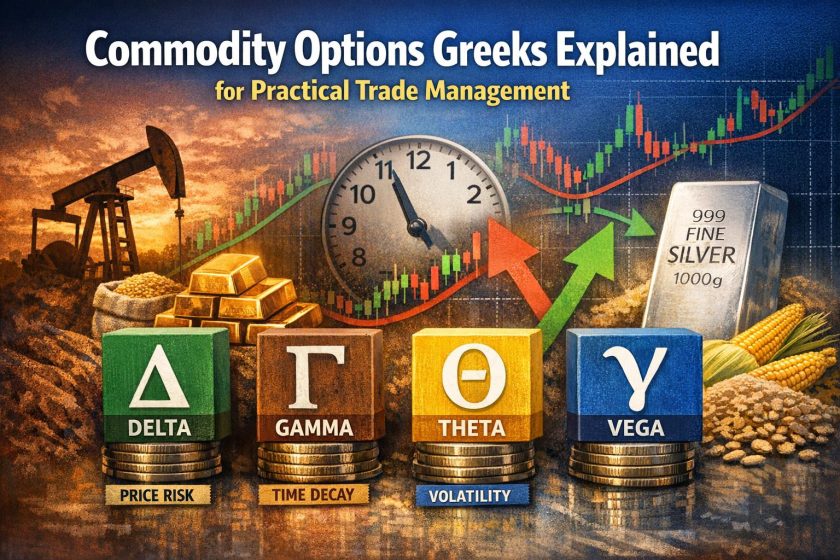
When participating in commodity options trading, understanding the Greeks is central to evaluating risk, pricing behavior, and portfolio exposure. Commodity options, whether written on futures contracts for crude oil, gold, natural gas, agricultural products, or industrial metals, derive their value from multiple variables. The Greeks are quantitative measures that describe how an option’s theoretical value is expected to change when one of these variables shifts while others remain constant.
In commodity markets, additional considerations such as seasonality, storage costs, geopolitical influences, and supply-demand imbalances can affect volatility and futures curves. Nonetheless, the Greeks provide a structured framework to measure and manage these dynamics. Rather than viewing options simply as directional tools, traders who understand the Greeks can assess probability, control risk more precisely, and design strategies aligned with defined objectives.
Delta
Delta measures the sensitivity of an option’s price to changes in the price of the underlying commodity futures contract. It answers the question: how much is the option expected to move if the underlying futures price moves by one unit?
For call options, delta ranges from 0 to 1. For put options, delta ranges from -1 to 0. A call option with a delta of 0.40 suggests that if the underlying commodity futures price increases by $1, the option’s value should increase by approximately $0.40, assuming other factors remain constant. Conversely, a put option with a delta of -0.40 would be expected to gain $0.40 if the futures price declines by $1.
Delta is not static. As the underlying futures price moves, delta changes. For options that are deeply in-the-money, delta approaches 1 for calls and -1 for puts. For out-of-the-money options, delta tends toward 0. At-the-money options typically have deltas near 0.50 for calls and -0.50 for puts, though this can vary based on volatility and time to expiration.
In commodity markets, where price swings can be significant due to macroeconomic data, weather patterns, or geopolitical disruptions, monitoring delta is especially important. Traders often use delta to gauge the directional exposure of their options portfolio relative to the underlying futures market.
Delta as a Hedge Ratio
One of delta’s primary uses is as a hedge ratio. Because delta approximates how much an option behaves like the underlying contract, it can be used to offset or replicate futures exposure.
For example, suppose a trader owns 10 crude oil futures contracts and wants to reduce downside risk without liquidating the position. Purchasing put options with a combined delta of -10 would theoretically offset the price sensitivity of those futures contracts. If each put has a delta of -0.50, the trader would need approximately 20 put options to create a delta-neutral hedge against 10 long futures contracts.
Hedging with delta involves regular recalibration. As the futures price moves and as time passes, delta changes. A hedge that was initially neutral may become directional. Maintaining a delta-neutral position often requires ongoing adjustments, particularly in volatile commodity markets.
Delta can also be aggregated across positions. A portfolio containing various option strikes and expirations can be reduced to a total net delta figure. This consolidated view allows traders to evaluate whether their overall exposure is bullish, bearish, or approximately neutral to movements in the underlying commodity.
Gamma
Gamma measures the rate of change of delta relative to changes in the underlying commodity price. If delta conveys first-order price sensitivity, gamma represents second-order sensitivity. It indicates how quickly delta itself will change as the futures price fluctuates.
A high gamma means that delta is highly sensitive to price changes. This is most evident in at-the-money options, particularly those approaching expiration. In such cases, even small movements in the underlying futures price can result in meaningful shifts in delta.
For example, an at-the-money gold call option with a delta of 0.50 and high gamma may see its delta increase to 0.65 after a relatively small upward move in gold futures. Similarly, a small downward move might reduce delta to 0.35. This dynamic accelerates gains or losses depending on the market direction.
Gamma is especially relevant in short-dated commodity options. As expiration approaches, gamma generally increases for at-the-money contracts. This heightened sensitivity can be beneficial for option buyers, whose deltas shift rapidly in their favor if the underlying price moves decisively. However, for option sellers, high gamma increases risk because adverse movements quickly increase directional exposure.
Gamma and Volatility
Gamma tends to be highest when options are at-the-money and near expiration. Commodity markets often exhibit episodic volatility, such as during crop reports for agricultural products or inventory announcements for energy markets. During these periods, at-the-money options may present elevated gamma.
For traders maintaining delta-neutral portfolios, gamma introduces complexity. A position that is delta-neutral today may become strongly directional tomorrow if gamma is high and the underlying price moves sharply. This phenomenon, known as gamma risk, requires active monitoring.
Positive gamma positions, typically held by option buyers, benefit from price movement in either direction because delta adjusts favorably. Negative gamma positions, common among option sellers, require more frequent hedging to control directional exposure. In commodity markets known for sharp gaps and limit moves, managing gamma exposure can be as important as managing delta.
Theta
Theta reflects the sensitivity of an option’s value to the passage of time. As expiration approaches, the time value embedded in an option gradually erodes. Theta measures the expected decrease in the option’s price for each day that passes, assuming all other factors remain constant.
For option buyers, theta is typically negative. The option loses value over time if the underlying futures price and volatility remain unchanged. For option sellers, theta is generally positive, reflecting the benefit of time decay.
In commodity markets, theta can behave differently depending on seasonal cycles and volatility expectations. For instance, agricultural options may experience shifts in time decay rates around planting or harvest periods when uncertainty changes. Energy options may exhibit shifts around peak demand seasons.
Theta is not linear. Time decay accelerates as expiration approaches, particularly for at-the-money options. Long-dated options lose value more slowly in the early stages but experience increasing theta as maturity nears.
Theta in Strategy
Strategies that aim to capture time decay often involve selling options or constructing spreads where the net theta is positive. For example, a trader who expects crude oil prices to remain in a defined range might sell both a call and a put at strike prices outside that range. If prices remain stable, the passage of time gradually reduces the value of both options.
However, positive theta positions often carry negative gamma. This means that large price movements can offset the gains from time decay. Effective management requires a balance between theta collection and the risk of adverse price shifts.
In commodities, where unexpected supply disruptions or policy changes can trigger rapid moves, relying solely on theta without considering other Greeks may expose the portfolio to disproportionate risk.
Vega
Vega measures an option’s sensitivity to changes in the implied volatility of the underlying futures contract. Implied volatility reflects the market’s expectation of future price variability. When implied volatility increases, option premiums generally rise because the probability of large price swings increases.
For example, if a natural gas call option has a vega of 0.10, a 1 percentage point increase in implied volatility would theoretically increase the option’s price by $0.10, holding other variables constant. Both call and put options typically have positive vega when purchased and negative vega when sold.
Commodity markets are particularly sensitive to volatility shifts. Weather developments, geopolitical tensions, central bank policies, and inventory data can all influence volatility expectations. As a result, vega risk can be substantial in commodities compared to more stable asset classes.
Long-dated options generally have higher vega than short-dated options because changes in volatility assumptions have a greater cumulative effect over longer time horizons.
Mitigating Vega Risks
Managing vega involves understanding how volatility may evolve relative to current market pricing. If implied volatility is historically low, purchasing options may provide exposure to potential volatility expansion. Conversely, if implied volatility is elevated relative to historical norms, selling options may capture premium, assuming volatility contracts.
Complex strategies such as straddles and strangles combine calls and puts to isolate volatility exposure. A long straddle, for instance, involves buying both an at-the-money call and put. This position typically has positive vega and benefits from rising volatility and substantial price movement in either direction.
In commodity markets, implied volatility often increases ahead of major reports and then declines afterward. Recognizing these patterns can inform decisions regarding when to hold or reduce vega exposure. Combining options across different maturities or strikes may help balance volatility sensitivity within a broader portfolio.
Rho
Rho measures the sensitivity of an option’s price to changes in interest rates. It estimates how much the option’s theoretical value will change if interest rates increase or decrease by one percentage point.
For call options, rho is generally positive. Rising interest rates tend to increase call values slightly. For put options, rho is typically negative. However, in commodity options—particularly short-dated ones—the effect of interest rate changes is often modest compared to delta, gamma, theta, and vega.
Rho becomes more relevant in long-dated commodity options, such as those used in structured hedging programs for producers or consumers planning several years ahead. Changes in interest rates affect the cost of carry and the pricing relationship between spot and futures markets, which in turn influences option valuation.
Rho in Risk Management
Although rho is frequently smaller in magnitude than other Greeks, incorporating it into a comprehensive risk framework helps refine pricing assumptions. In periods of shifting monetary policy or significant interest rate adjustments, long-dated commodity options may reflect measurable sensitivity.
For institutions managing extensive commodity exposures, even small rho effects can accumulate across large positions. Integrating interest rate scenarios into valuation models supports more accurate stress testing.
Interrelationships Among the Greeks
While each Greek measures sensitivity to a specific variable, they function interdependently. Adjustments made to control delta often alter gamma. Positions designed to collect theta frequently involve exposure to negative gamma and vega. Managing vega may change the portfolio’s overall delta profile.
For example, a trader who sells at-the-money oil options to benefit from time decay assumes negative gamma and negative vega exposure. If oil prices begin trending sharply, delta shifts quickly against the position due to gamma. Simultaneously, rising volatility increases option premiums due to vega, amplifying potential losses.
Because of these interactions, effective commodity options management involves evaluating the entire Greek profile rather than focusing on a single metric. Advanced risk systems often display all five primary Greeks collectively, allowing traders to identify imbalances.
Practical Applications in Commodity Markets
Application of the Greeks extends beyond speculative trading. Commercial producers and consumers of commodities frequently use options for hedging. A grain producer may purchase put options to protect against falling prices while maintaining upside participation. Understanding delta provides insight into how closely the hedge tracks futures price movements, while vega indicates how volatility changes may influence hedge effectiveness.
Refiners and energy companies may construct structured option positions to manage input costs. Monitoring theta helps evaluate the time-related cost of protection, while gamma reveals how hedge sensitivity may evolve during volatile periods.
Portfolio managers with diversified exposure across metals, energy, and agriculture may aggregate Greek values across asset classes. This approach clarifies total directional exposure, overall sensitivity to volatility shifts, and the rate of time decay impacting the portfolio.
Stress testing scenarios that incorporate simultaneous changes in price, volatility, and time passage can provide a more comprehensive assessment of risk. Because commodity markets can experience correlated shocks—such as geopolitical events influencing multiple energy contracts—integrating multi-Greek analysis supports better preparedness.
Conclusion
A comprehensive understanding of delta, gamma, theta, vega, and rho equips commodity options traders with a structured method to analyze price sensitivity, volatility exposure, time decay, and interest rate effects. Each Greek isolates the impact of a single variable while assuming others remain constant, but in practice these variables interact continuously.
In commodity markets characterized by cyclical demand, supply uncertainty, and episodic volatility, the Greeks provide a systematic framework for trade construction and risk control. By evaluating each metric individually and as part of an integrated profile, traders and hedgers can make informed adjustments that align with defined risk parameters and strategic objectives.
This article was last updated on: April 18, 2026