The Role of Implied Volatility in Commodity Options Trading
By : Admin -
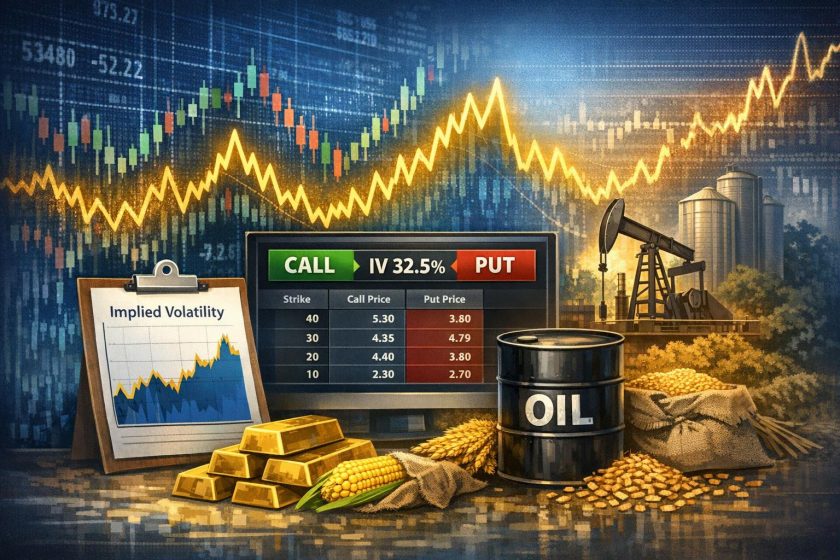
The Importance of Implied Volatility in Commodity Options Trading
Commodity options trading represents a sophisticated segment of the derivatives market in which participants attempt to manage exposure to price fluctuations in physical goods such as crude oil, natural gas, gold, copper, corn, soybeans, and other agricultural products. These commodities are influenced by a wide range of factors including geopolitical developments, weather events, global supply chains, interest rate dynamics, and macroeconomic trends. Within this complex environment, implied volatility serves as a central analytical metric. It influences option pricing, trading strategy design, capital allocation, and risk management decisions.
While many traders focus on the directional movement of commodity prices, experienced participants recognize that volatility itself can be a tradable and measurable component of market expectations. Implied volatility connects option premiums to forward-looking market perceptions, making it one of the most informative variables in commodity options trading.
Understanding Implied Volatility
Implied volatility represents the market’s consensus estimate of the magnitude of potential price movement in an underlying commodity over the life of an option. Unlike historical volatility, which is derived from past price fluctuations, implied volatility is extracted from current option prices and therefore reflects expectations rather than past behavior.
When option premiums rise without a significant change in the underlying commodity price, the increase often reflects a higher implied volatility. This suggests that market participants anticipate larger price swings in the near future. Conversely, when option premiums fall and other factors remain relatively stable, implied volatility may be declining, indicating an expectation of more limited movement.
Importantly, implied volatility does not indicate direction. A rise in implied volatility does not imply that prices will necessarily increase or decrease; rather, it signals that traders expect larger movements in either direction. In commodity markets, this distinction is particularly significant because supply shocks, regulatory decisions, or environmental conditions can produce sudden pricing shifts that are not inherently directional at the moment of volatility expansion.
Implied Volatility Versus Historical Volatility
To fully appreciate implied volatility, it is useful to compare it with historical volatility. Historical volatility is a statistical measure calculated from previous price data. It indicates how much a commodity’s price has fluctuated over a defined period, such as 30, 60, or 90 days.
Implied volatility, in contrast, is forward-looking. It reflects how much volatility is being priced into options by the market. The difference between these two measures can provide insight into whether options are relatively expensive or inexpensive. If implied volatility is significantly higher than historical volatility, it suggests that traders expect future uncertainty to exceed recent price behavior. If it is lower, the market may be expecting calmer conditions ahead.
Commodity markets frequently experience divergence between historical and implied volatility due to event-driven uncertainty. For example, an approaching OPEC meeting may elevate implied volatility in crude oil options even if recent price movements have been stable. Similarly, agricultural commodities may display elevated implied volatility ahead of critical weather forecasts or crop reports.
Calculating Implied Volatility
Implied volatility is not directly observable; it is derived from option pricing models. The most commonly referenced framework is the Black-Scholes Model, though modifications such as the Black model are often used for futures-based commodity options. These models incorporate variables including the current price of the underlying commodity, the strike price, time to expiration, risk-free interest rate, and observed option premium.
Because all other variables can be identified directly from market data, implied volatility is the only unknown input. By solving the pricing equation for volatility, traders determine the level of implied volatility consistent with the observed option price.
In commodity markets, many options are written on futures rather than the physical commodity itself. This introduces additional elements such as cost of carry, storage expenses, and convenience yield. As a result, the volatility extracted from these option prices reflects expectations surrounding future contract pricing dynamics rather than solely spot price movements.
The Structure of Implied Volatility in Commodity Markets
Implied volatility in commodity markets is not uniform across strike prices or maturities. Instead, it forms patterns often referred to as the volatility smile or volatility skew. These patterns emerge because market participants assign different perceived risks to various price levels.
In crude oil options, for instance, out-of-the-money put options may carry higher implied volatility than at-the-money contracts if traders are concerned about sharp downside moves triggered by demand shocks. In agricultural markets, implied volatility may rise for calls if traders anticipate potential supply shortages caused by weather disruptions.
Term structure also plays an important role. Short-dated commodity options often exhibit higher implied volatility prior to scheduled reports or events. Longer-dated options may display lower or more stable volatility if long-term supply-demand balances are perceived as predictable. Understanding how implied volatility varies across expiration dates provides insight into how the market expects uncertainty to evolve over time.
The Implications of Implied Volatility in Trading Strategies
Implied volatility directly influences the design and execution of commodity option strategies. Because option premiums embed volatility expectations, traders must assess whether current implied volatility levels align with their own forecasts.
When implied volatility is relatively high compared to historical norms or fundamental expectations, option sellers may find opportunities to collect elevated premiums. Strategies such as covered calls, short straddles, short strangles, or credit spreads can benefit if realized volatility ultimately proves lower than what was priced into the options.
Conversely, when implied volatility is relatively low, option buyers may consider strategies such as long calls, long puts, long straddles, or debit spreads. If future price movements exceed the market’s subdued expectations, these positions may gain value through both directional movement and potential volatility expansion.
Professional traders often analyze the percentile rank of implied volatility relative to its historical range. This contextual approach helps determine whether an option’s premium is expensive or inexpensive compared to past conditions for the same commodity and expiration period.
Volatility Trading and Relative Value
Some participants focus specifically on trading changes in implied volatility rather than taking directional commodity exposure. This can involve constructing delta-neutral positions such as straddles or strangles to isolate volatility risk. If implied volatility rises after the position is established, the value of the combined options may increase even if the underlying commodity price remains relatively stable.
Relative value strategies may also involve comparing implied volatility across related commodities. For example, traders may analyze volatility differentials between crude oil and refined products such as gasoline or heating oil. Significant discrepancies could reflect market inefficiencies or differing supply-demand expectations.
Additionally, calendar spreads allow traders to express views on differences between short-term and long-term volatility. By buying an option with one expiration and selling another, traders attempt to capture shifts in the term structure of implied volatility.
Impact on Option Greeks
Implied volatility plays a central role in determining the Greeks, which measure option sensitivity to various factors. The most directly related Greek is vega, representing sensitivity to changes in implied volatility. A position with positive vega increases in value when implied volatility rises, while a position with negative vega benefits from volatility contraction.
Other Greeks are indirectly influenced. Gamma, which measures sensitivity to changes in delta, can become more pronounced when volatility expectations shift. Theta, reflecting time decay, interacts with implied volatility because higher-volatility options typically carry greater time value, affecting the rate at which the option’s premium erodes as expiration approaches.
Understanding these relationships is essential for managing complex multi-leg commodity option positions, particularly when volatility conditions change rapidly.
Risk Management Considerations
Effective risk management in commodity options trading requires careful monitoring of implied volatility. Sudden changes in volatility can affect option valuations even in the absence of significant moves in the underlying commodity price.
For producers and consumers of commodities, implied volatility informs hedging decisions. A gold mining company evaluating put options for price protection must assess whether current implied volatility justifies the cost of the hedge. If implied volatility is elevated due to short-term uncertainty, the premium required for protection may be substantially higher.
Similarly, energy companies using options to hedge fuel costs need to consider volatility cycles. During periods of geopolitical uncertainty, implied volatility in energy markets may surge. Hedging during such periods could increase costs, prompting firms to weigh timing considerations.
Investment funds and proprietary traders also use implied volatility to determine appropriate position sizing. Higher volatility environments typically justify smaller directional exposures due to increased price uncertainty. Portfolio stress testing often incorporates volatility scenarios to evaluate potential mark-to-market swings.
Hedge Ratios and Dynamic Adjustments
Implied volatility affects hedge ratios by altering option deltas. As volatility shifts, the delta of an existing option position may change even if the underlying price remains stable. Traders managing delta-neutral portfolios must therefore adjust positions dynamically to maintain desired exposures.
Changes in implied volatility can also influence the probability distribution of expected price outcomes. By incorporating volatility assumptions into scenario analysis, traders can evaluate potential drawdowns under different market conditions. This approach supports more disciplined capital management.
Implied Volatility as a Measure of Market Sentiment
Commodity markets often react to new information in ways that first manifest through implied volatility changes. For example, ahead of major government reports such as crop production estimates or energy inventory publications, implied volatility frequently increases as traders prepare for potential surprises.
A sustained rise in implied volatility across strike prices can indicate heightened uncertainty about macroeconomic conditions or geopolitical developments. Conversely, declining volatility may suggest broad market consensus or reduced event risk.
In some commodity segments, volatility indexes have been developed to track implied volatility over time. These measures provide a benchmark for assessing whether current conditions are above or below long-term averages, offering additional context for decision-making.
Event-Driven Volatility
Event-driven volatility is common in commodity markets. Agricultural commodities are sensitive to weather developments, planting reports, and harvest data. Energy commodities respond to production policy announcements and geopolitical events. Metals markets may react to industrial demand projections and currency fluctuations.
Traders often anticipate temporary spikes in implied volatility before scheduled announcements. After the event passes and uncertainty resolves, implied volatility may decline. This pattern, sometimes described as volatility compression, can influence the timing of both option purchases and sales.
Liquidity and Market Microstructure
Implied volatility levels are also shaped by market liquidity and trading activity. Highly liquid commodity options markets, such as those for crude oil and gold, tend to exhibit narrower bid-ask spreads and more efficient volatility pricing. Less liquid markets may display irregular volatility readings due to limited participation.
Institutional hedging flows can influence implied volatility independently of immediate price expectations. For example, if a large number of producers seek downside protection simultaneously, increased demand for put options can elevate implied volatility on those strikes. This supply-demand dynamic highlights that implied volatility is not solely a forecast but also reflects transactional pressures.
Limitations of Implied Volatility
Although implied volatility is a valuable metric, it is not a precise predictor of future realized volatility. Market expectations can prove inaccurate, particularly during unexpected disturbances or structural shifts.
Model assumptions present additional limitations. Pricing models often assume constant volatility and lognormal price distributions, while commodity markets may exhibit skewed or discontinuous price behavior. Sudden supply disruptions or regulatory interventions can produce price gaps that deviate from standard modeling assumptions.
Furthermore, implied volatility can be influenced by technical positioning and short-term speculative activity. Traders must therefore interpret volatility data in conjunction with broader fundamental and macroeconomic analysis.
Integrating Implied Volatility into a Comprehensive Framework
A disciplined approach to commodity options trading integrates implied volatility analysis with fundamental research, technical analysis, and macroeconomic evaluation. By combining volatility metrics with assessments of supply-demand balances, seasonal trends, and geopolitical risk factors, traders gain a more comprehensive understanding of market conditions.
Risk-adjusted return expectations often depend on the relationship between implied volatility and projected realized volatility. If a trader anticipates greater price fluctuation than is currently priced into options, purchasing volatility may be justified. If expectations are for more stable conditions than reflected in option premiums, selling volatility could align with the forecast.
Professional trading operations often maintain volatility dashboards that track historical ranges, percentiles, term structures, and skew dynamics. These tools enhance consistency in decision-making and reduce reliance on subjective judgment.
Conclusion
Implied volatility occupies a central position in commodity options trading. It bridges option pricing theory, market expectations, and practical risk management. By reflecting the market’s forward-looking assessment of potential price movement, implied volatility influences premium levels, strategic selection, hedge construction, and portfolio exposure.
A thorough understanding of implied volatility enables traders to evaluate whether option premiums are aligned with anticipated market conditions. It informs decisions regarding buying or selling volatility, structuring spreads, managing delta and vega exposure, and adjusting hedge ratios. Although not a flawless predictor of future price behavior, it remains a critical variable in interpreting option market dynamics.
As commodity markets continue to respond to global economic integration, technological shifts, environmental developments, and geopolitical uncertainty, implied volatility will remain a key analytical tool. Traders who incorporate disciplined volatility assessment into their broader frameworks are better positioned to navigate the structural complexity and inherent uncertainty that define commodity derivatives markets.
This article was last updated on: April 5, 2026