Bear Put Spreads in Commodity Options for Directional Setups
By : Admin -
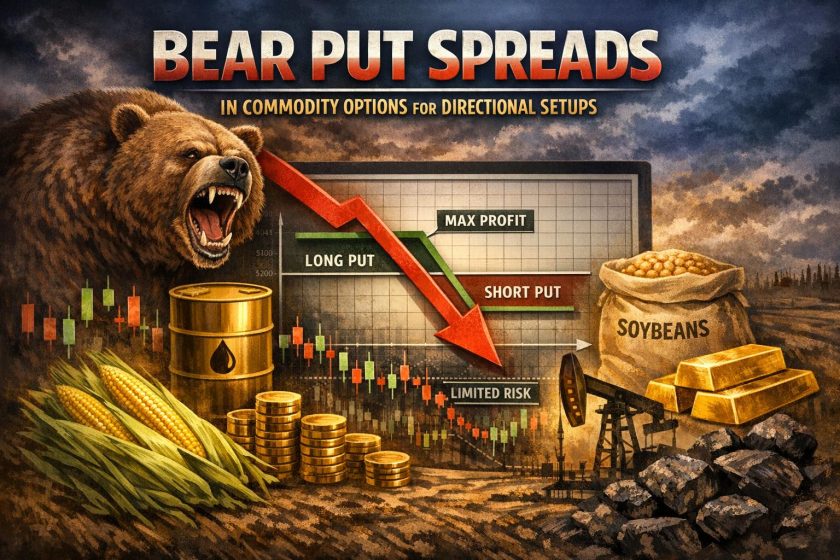
Understanding Bear Put Spreads
In the realm of commodity options trading, the bear put spread is a structured strategy used by traders who anticipate a decline in the price of an underlying commodity over a defined period. Commodities such as crude oil, natural gas, gold, silver, corn, and soybeans are frequently traded through options contracts, allowing market participants to express directional views while managing capital exposure. A bear put spread is constructed by purchasing one put option and simultaneously selling another put option on the same underlying commodity, both sharing the same expiration date but with different strike prices.
This approach creates a defined-risk, defined-reward position. Unlike the outright purchase of a single put option, the bear put spread offsets part of the cost through the sale of a second put. In exchange for this reduced upfront cost, the trader accepts a cap on potential profit. The strategy is therefore particularly relevant in market environments where a moderate, rather than extreme, price decline is expected.
The Mechanics of Bear Put Spreads
A bear put spread combines two option legs into a single position. The first leg is a long put option, typically established at a higher strike price. The second leg is a short put option, opened at a lower strike price. Because both options share the same expiration date, the position behaves predictably as expiration approaches.
To illustrate how the structure works, assume a trader expects the price of crude oil, currently trading at $80 per barrel, to decline modestly over the next two months. The trader might buy a put option with a strike price of $80 and sell a put option with a strike price of $70, both expiring in the same month. The purchased put grants the right to sell at $80, while the sold put obligates the trader to buy at $70 if assigned.
The net cost of entering the position is determined by subtracting the premium received from selling the lower strike put from the premium paid for purchasing the higher strike put. This difference represents the net premium and constitutes the maximum potential loss of the spread.
At expiration, the value of the spread depends on where the underlying commodity’s price settles relative to the two strike prices. If the price remains above the higher strike price, both puts expire worthless and the entire premium paid is lost. If the price falls below the lower strike price, both options are in the money, but the maximum gain is realized because the difference between the strike prices has been fully captured.
Initial Investment and Risk Profile
The initial investment in a bear put spread is limited to the net premium paid. This cost is generally lower than purchasing a single at-the-money put because the premium collected from the short put offsets part of the expense. The lower capital requirement can improve capital efficiency and allow traders to allocate funds across multiple positions if desired.
The maximum loss occurs if the commodity price remains at or above the strike price of the long put at expiration. In such a case, neither option holds intrinsic value, and the trader forfeits the net premium paid. Unlike short selling a futures contract, the loss cannot exceed this initial amount.
The maximum profit is realized when the underlying commodity settles at or below the strike price of the short put. At that level, the long put reaches its maximum intrinsic value relative to the short put. The total potential profit equals the difference between the two strike prices minus the net premium paid to establish the spread. Because both maximum gain and maximum loss are known in advance, traders can quantify the risk-to-reward ratio before initiating the trade.
Payoff Dynamics Over Time
The performance of a bear put spread is influenced by the passage of time and changes in implied volatility. As expiration approaches, time decay accelerates, affecting both the long and short put positions. Since the trader is long one option and short another, the effects of time decay partially offset each other. However, the long put typically has higher sensitivity to price changes due to its higher strike, which can create a net directional exposure.
If the commodity price declines steadily toward the lower strike, the spread increases in value. If the decline is gradual and remains between the two strikes for much of the holding period, the position may benefit from both intrinsic and residual time value. Conversely, if the commodity price remains stable or rises, the long put loses value faster than gains generated by the short put, resulting in a net decrease in spread value.
Implied volatility also affects pricing. Higher volatility generally increases option premiums. If volatility rises after the spread is initiated, the long put may gain value at a greater rate than the short put, particularly if the long put is closer to the money. However, because the spread contains both a purchased and a sold option, the net impact is typically less pronounced than holding a single long put.
When to Consider Bear Put Spreads
Bear put spreads are most appropriate when a trader expects a moderate decline in the price of a commodity within a specific timeframe. In commodity markets, price movements are often influenced by supply and demand imbalances, geopolitical developments, seasonal production cycles, weather patterns, and macroeconomic indicators. If a trader anticipates a measured decrease—for example, due to rising inventories in crude oil or improved harvest forecasts in agricultural commodities—the bear put spread can align well with that outlook.
If a substantial and rapid decline is anticipated, purchasing a single put option may produce higher absolute returns because the profit is not capped. However, outright puts require a higher upfront premium and expose the trader to complete premium loss if the expected move fails to materialize. The bear put spread reduces that cost and introduces a more balanced risk-reward structure.
The strategy can also be appropriate in markets characterized by relatively high option premiums. By selling a lower strike put, the trader recovers part of the inflated premium cost, making entry more economical compared to purchasing a standalone put option.
Strategic Considerations in Strike Selection
The selection of strike prices plays a significant role in shaping the behavior of a bear put spread. The distance between the higher and lower strikes determines both the maximum potential gain and the required price movement to achieve that gain.
A narrower spread, in which the strike prices are closer together, typically requires a smaller adverse move in the underlying to reach maximum profitability. However, the maximum gain is correspondingly smaller. A wider spread increases the potential profit but demands a larger price decline to capture the full benefit.
Commodity analysis forms the foundation of strike selection. Fundamental analysis may involve examining production forecasts, inventory levels, export data, and macroeconomic indicators. For energy commodities, factors such as refinery utilization rates and geopolitical tensions may be relevant. In agricultural markets, weather forecasts and planting acreage reports often influence price expectations. Technical analysis can complement these inputs by identifying resistance levels, support zones, and trend momentum indicators.
Volatility considerations also influence strike choice. When implied volatility is elevated, option premiums are higher. Traders may choose to structure spreads that take advantage of this pricing by selling options with substantial time value. When volatility is low, the trader may seek strikes that are closer to the current market price to ensure that modest movements generate measurable gains.
Comparison with Alternative Bearish Strategies
The bear put spread is one of several strategies available to traders with bearish expectations. Another approach is short selling a commodity futures contract. Futures provide linear exposure to price movements but involve potentially unlimited risk if the price rises sharply. In contrast, the bear put spread strictly limits downside exposure.
An outright long put offers uncapped profit potential relative to price declines but comes at higher cost. If the price stabilizes or rises slightly, the entire premium may erode. The bear put spread reduces that premium at the expense of capping profits.
There is also the bear call spread, which involves selling a call option and buying a higher strike call for protection. While both strategies are bearish and defined-risk, the bear put spread requires paying a net premium upfront, whereas a bear call spread often results in a net credit. The selection of one over the other may depend on margin requirements, volatility conditions, and individual risk preferences.
Impact of Early Assignment and Exercise
In commodity options traded on futures exchanges, early exercise is possible for American-style options. If the short put becomes significantly in the money prior to expiration, there is a possibility of early assignment. In that event, the trader may be assigned a long futures position at the lower strike price. However, the long put still provides protection, allowing the trader to exercise the higher strike put if necessary.
Understanding contract specifications, margin requirements, and settlement procedures is essential when managing a bear put spread in commodity markets. Physical delivery considerations or cash-settled contract terms may affect how positions are handled near expiration.
Benefits of Bear Put Spreads
One of the primary benefits of the bear put spread is its limited risk profile. The trader knows in advance the maximum amount that can be lost, which simplifies portfolio risk management. This clarity allows for more precise capital allocation decisions.
Another benefit is cost efficiency. By selling a lower strike put, the trader offsets some of the expense associated with the long put purchase. This can make bearish positioning more accessible, particularly in markets where option premiums are elevated.
The strategy also provides defined reward expectations. Because both the minimum and maximum outcomes are calculable at entry, traders can evaluate whether the projected return justifies the risk undertaken. This structure aligns well with disciplined trading plans that emphasize predefined entry and exit criteria.
Drawbacks and Limitations
Despite its advantages, the bear put spread has notable limitations. The most significant is the capped profit potential. If the commodity price declines far beyond the lower strike, the trader does not participate in additional gains beyond the spread width minus the premium paid.
The strategy also requires accurate timing. If the expected decline does not occur before expiration, time decay erodes the value of the long put. Even if the broader trend eventually turns downward, the position may not benefit if the timing is misaligned.
Liquidity is another consideration. Some commodity options markets have wider bid-ask spreads than equity options. This can increase transaction costs and make precise execution more challenging, particularly for larger orders.
Practical Risk Management Considerations
Effective use of bear put spreads depends on position sizing and monitoring. Traders often determine in advance how much of their total portfolio can be allocated to any single strategy. Because the maximum loss is known, calculating exposure relative to account size is straightforward.
Adjustments may be considered if market conditions change. For example, if the commodity price declines rapidly soon after entry, the spread may approach its maximum value well before expiration. In such a situation, some traders may choose to close the position early to lock in gains, rather than waiting for expiration.
Conversely, if the commodity price moves higher and invalidates the initial bearish outlook, closing the spread prior to expiration may preserve a portion of the premium by avoiding complete time decay.
Conclusion
The bear put spread is a structured options strategy that enables traders in commodity markets to express a bearish view with defined risk and defined reward. By purchasing a higher strike put and selling a lower strike put with the same expiration, the trader establishes a position that benefits from moderate price declines while limiting both potential gains and losses.
Its suitability depends on accurate market assessment, appropriate strike selection, and careful attention to timing and volatility conditions. While it does not provide unlimited profit potential, the strategy offers capital efficiency, reduced risk exposure, and a clear payoff structure. When integrated into a broader risk management framework, the bear put spread can serve as a practical tool for navigating anticipated downward movements in commodity prices.
This article was last updated on: July 29, 2026