How to Use Credit Spreads in Commodity Options Markets
By : Admin -
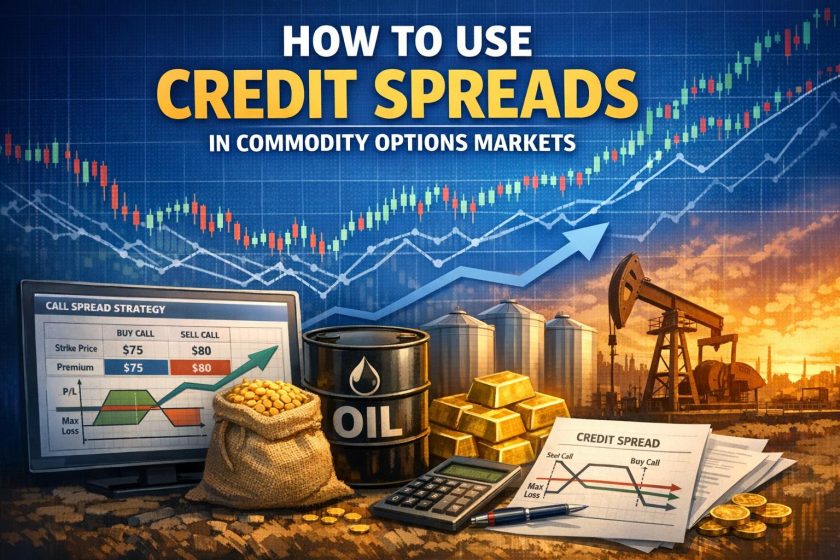
Understanding Credit Spreads in Commodity Options Markets
In the context of commodity derivatives, credit spreads represent a structured options strategy designed to generate premium income while maintaining defined risk parameters. Commodity markets differ from equity markets in several structural aspects, including the use of futures contracts as underlying instruments, standardized contract sizes, and exposure to factors such as weather, geopolitical events, production cycles, and transportation constraints. Within this environment, credit spreads offer a method for expressing directional or neutral views without assuming unlimited loss exposure.
A credit spread involves the simultaneous sale and purchase of options contracts on the same underlying commodity futures contract, with the same expiration date but different strike prices. Because the option sold carries a higher premium than the option purchased, the trader receives a net credit at the outset. This initial premium represents the maximum potential profit if the position is held to expiration and conditions remain favorable. The strategy is structured so that maximum loss is predefined and occurs only if the market moves significantly against the position.
Credit spreads are commonly used in markets such as crude oil, natural gas, gold, silver, corn, soybeans, and other agricultural or energy products. Proper understanding requires familiarity with how commodity options are priced, how futures contracts function, and how volatility influences premium values.
Definition and Mechanics of a Credit Spread
A credit spread is created by selling one option and simultaneously buying another option of the same type (both calls or both puts), with a different strike price but identical expiration. Because the premium collected from the short option exceeds the premium paid for the long option, the trader receives a net credit when initiating the position.
In commodity markets, options are typically written on futures contracts rather than on the physical commodity itself. For example, a crude oil option may grant the right to enter into a crude oil futures contract at a specified strike price. This distinction is important because the value of the option depends on futures pricing dynamics rather than spot prices alone.
The defining characteristics of a credit spread include:
Defined maximum profit, equal to the net premium received.
Defined maximum loss, equal to the difference between the strike prices minus the net premium.
Time sensitivity, as the passage of time generally works in favor of the seller due to time decay.
Dependence on volatility, since options premiums are influenced by expected price fluctuations.
Unlike uncovered option writing, where potential losses may be unlimited, credit spreads are classified as limited-risk strategies because the long option purchased acts as a hedge against extreme price movement.
Types of Credit Spreads in Commodity Markets
In practice, two primary forms of credit spreads are widely used: the bull put spread and the bear call spread. Each strategy reflects a different market outlook and price expectation.
Bull Put Spread
A bull put spread is implemented when a trader expects the underlying commodity futures price to remain stable or increase moderately. The strategy involves selling a put option with a higher strike price while simultaneously purchasing another put option with a lower strike price.
The short put generates premium income. The purchased lower-strike put limits downside risk in the event of a significant decline in the commodity’s price. If, at expiration, the futures price remains above the higher strike price, both options expire worthless, and the trader retains the entire net credit.
Consider an example in the gold futures market. Suppose gold futures are trading at 2,000. A trader sells a 1,950 put and buys a 1,900 put with the same expiration. If the premium received from the 1,950 put is greater than the premium paid for the 1,900 put, the resulting transaction produces a net credit. As long as gold futures remain above 1,950 at expiration, the maximum profit is realized.
If the price declines below the lower strike of 1,900, the maximum loss is limited to the 50-point difference between strikes minus the credit received. The long put acts as insurance that prevents losses from exceeding this defined amount.
Bear Call Spread
A bear call spread is utilized when a trader expects the commodity futures price to decline or remain below a certain level. This strategy involves selling a call option at a lower strike price while purchasing another call option at a higher strike price.
The short call provides premium income, while the long call caps potential losses if the commodity price rises sharply. If, at expiration, the futures price remains below the lower strike price, both calls expire worthless, and the net credit is retained.
For instance, in the crude oil market, if futures trade at 75 per barrel, a trader might sell an 80 call and purchase an 85 call. If prices remain at or below 80 at expiration, the options expire without value, and the premium received constitutes the profit. Should crude oil rise above 85, the long call limits the loss to the spread width minus the net credit.
Both bull put spreads and bear call spreads enable traders to express directional views with limited exposure to extreme price movements.
Risk and Reward Structure
Credit spreads are structured with clear risk–reward parameters at the outset. The maximum profit is the net premium received, and it cannot increase beyond that level regardless of how favorable price movement may be. This contrasts with strategies such as outright futures positions, where gains are theoretically unlimited.
The maximum loss is calculated as the difference between the strike prices minus the net credit received. This loss occurs if the underlying futures price moves beyond the protective long option strike by expiration.
An important consideration is that the probability of achieving maximum profit is often higher than with strategies that aim for large directional gains. This is because credit spreads can succeed even if the market moves only modestly or remains stable. However, the tradeoff is that the profit potential is capped.
In commodity markets, price swings can be abrupt due to weather events, inventory reports, crop forecasts, supply disruptions, or geopolitical developments. Therefore, understanding the volatility profile of the underlying commodity is essential when selecting strike prices.
The Role of Volatility
Volatility significantly impacts credit spread pricing and potential outcomes. Options premiums increase when implied volatility rises, reflecting greater expectations of price movement. Because credit spreads involve selling options, traders often seek to initiate positions when implied volatility is relatively elevated.
Higher volatility typically results in larger premiums and therefore higher potential credit. However, elevated volatility also implies greater risk of substantial price movement. A careful balance between premium size and probability of adverse movement must be maintained.
Implied volatility may fluctuate seasonally in agricultural commodities. For example, corn and soybean markets often experience increased volatility during planting and harvest seasons. Energy markets may react sharply to geopolitical tensions or inventory announcements. Metal markets can be influenced by macroeconomic indicators and currency fluctuations.
By analyzing historical volatility patterns, traders may better identify periods when credit spreads offer favorable risk–reward characteristics.
Time Decay and Option Greeks
Time decay, commonly referred to as theta, plays a central role in credit spread performance. Option values decline as expiration approaches, assuming other factors remain constant. Because net premium is received at initiation, the trader benefits from this decay effect as long as the commodity price remains within a defined range.
Other option Greeks are also relevant. Delta measures sensitivity to price movement in the underlying futures contract. Credit spreads are often constructed using out-of-the-money options, which generally have lower delta values and lower probability of finishing in-the-money.
Gamma measures the rate of change of delta. Close to expiration, gamma can increase, leading to rapid changes in position sensitivity if the market approaches a strike price. Vega measures sensitivity to changes in implied volatility. A contraction in volatility typically benefits short option positions, while volatility expansion may increase losses if price movement accompanies it.
Understanding these dynamics is particularly important in commodity markets, where sudden fundamental developments can rapidly alter price expectations.
Margin Requirements and Capital Efficiency
Trading credit spreads in commodity options usually requires a margin account. Although the strategy defines risk, brokers and clearing firms typically require margin to ensure the trader can meet potential obligations.
Compared with naked option writing, credit spreads generally require lower margin because the long option provides protection. Compared with outright futures contracts, spreads may offer more capital efficiency, as risk is predefined.
However, margin requirements can change depending on market conditions. Exchanges may increase margin during periods of high volatility. Traders must ensure that they maintain sufficient capital to avoid forced liquidation of positions at unfavorable prices.
Strategic Applications in Commodity Markets
Credit spreads may be used in several strategic contexts. Some traders apply them to generate regular premium income in range-bound markets. Others deploy them as part of broader portfolio hedging frameworks. For example, a producer of a physical commodity might use options spreads to complement hedging positions in futures markets.
In agricultural markets, bull put spreads can align with expectations of stable or rising prices following supply concerns. In energy markets, bear call spreads may reflect expectations that production increases will cap price rallies. Precious metals traders may use spreads around macroeconomic announcements, positioning for limited movement rather than large directional shifts.
In all cases, selection of strike prices is informed by probability estimates, chart analysis, supply–demand fundamentals, and volatility metrics. Proper calibration of spread width and expiration date is necessary to align the strategy with anticipated market behavior.
Early Assignment and Expiration Considerations
Commodity options that are American-style may be exercised before expiration. Although early assignment is less common when options are out-of-the-money, it can occur if they become sufficiently in-the-money, particularly near expiration.
Because credit spreads involve short options, traders must be aware of potential assignment risk. If assigned, a trader may acquire a long or short futures position. The long option within the spread can then be used to offset exposure, but active management may be necessary.
At expiration, if the underlying futures price settles between the two strike prices, partial loss may result. If it settles beyond the protective strike, the maximum loss is realized. Monitoring settlement procedures and contract specifications is essential, as commodity futures may enter delivery periods with specific obligations.
Limitations and Risk Factors
Despite defined risk, credit spreads are not without challenges. Profit potential is limited to the initial credit, meaning the trader does not benefit from large favorable price moves beyond that amount. Additionally, sudden price gaps can generate mark-to-market losses before expiration even if final outcomes prove manageable.
Liquidity varies among commodity options contracts. Thinly traded markets may present wider bid–ask spreads, increasing transaction costs and reducing efficiency. Traders should evaluate trading volume and open interest when selecting contracts.
Another consideration involves correlation among commodities. External macroeconomic shocks may simultaneously affect multiple markets, amplifying risk for traders maintaining several spread positions across different commodities.
Practical Approach to Implementation
Successful application of credit spreads in commodity options markets generally involves systematic analysis rather than discretionary impulse trading. Traders often begin by evaluating long-term and short-term price trends, volatility levels, and fundamental supply–demand indicators.
Strike prices are often selected outside key technical support or resistance levels, providing a buffer against moderate price fluctuations. Expiration dates are chosen to balance time decay with exposure to major scheduled reports or seasonal factors.
Position sizing remains a critical determinant of risk management. Even though each spread has limited risk, multiple simultaneous positions can collectively create significant exposure. Capital allocation strategies should reflect overall portfolio objectives and tolerance for drawdowns.
Continuous monitoring throughout the trade lifecycle allows for adjustments if market conditions change. In some cases, traders may close positions early to capture a substantial portion of the available profit, thereby reducing exposure to unexpected events near expiration.
Conclusion
Credit spreads in commodity options markets offer a disciplined framework for generating income while maintaining defined risk. By combining short and long options at different strike prices within the same expiration, traders receive an upfront premium and establish clearly bounded profit and loss parameters.
The bull put spread and bear call spread provide mechanisms for expressing moderately bullish or bearish views without requiring large directional moves. Their effectiveness depends on careful assessment of volatility, time decay, margin requirements, and the unique characteristics of each commodity market.
While credit spreads limit losses compared with uncovered option positions, they require thoughtful analysis, appropriate capital management, and awareness of futures market dynamics. Traders who understand how pricing, volatility, and expiration interact within commodity derivatives markets can integrate credit spreads into broader trading or hedging strategies with a structured and methodical approach.
This article was last updated on: August 5, 2026