Bull Call Spreads in Commodity Options: When and Why Traders Use Them
By : Admin -
Understanding Bull Call Spreads
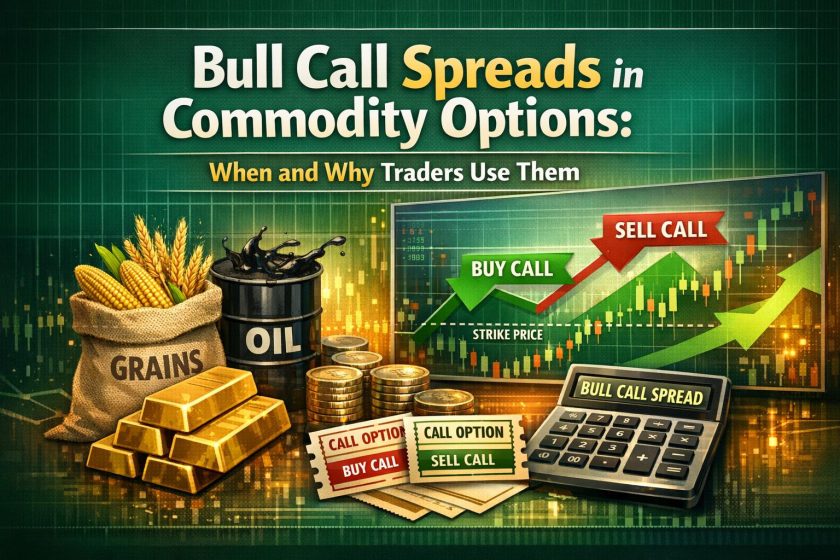
In the world of commodity options, traders employ a range of structured positions to align potential returns with clearly defined risk parameters. Among these strategies, the bull call spread occupies a central position for participants seeking exposure to moderately rising prices without assuming the full cost or downside of a single long call. The structure is straightforward: a trader purchases a call option at a lower strike price and simultaneously sells another call option at a higher strike price, using the same underlying commodity and the same expiration date. The combined position creates a defined-risk, defined-reward profile that appeals to traders who value clarity in advance of entering a trade.
Commodity markets, which include energy products, metals, and agricultural goods, often experience price fluctuations influenced by macroeconomic trends, weather patterns, geopolitical shifts, supply disruptions, and cyclical demand changes. In environments where price movement is expected to be positive but not extreme, the bull call spread can provide a measured method of participation.
Structural Mechanics of the Bull Call Spread
A bull call spread consists of two legs executed simultaneously. The first leg involves buying a call option with a strike price below the anticipated future price of the commodity. This long call gives the trader the right, but not the obligation, to purchase the underlying asset at the specified strike price before or at expiration. The second leg involves selling a call option with a higher strike price. By selling this call, the trader assumes the obligation to deliver the underlying asset at that higher strike price if assigned.
Because the trader receives a premium from the short call and pays a premium for the long call, the net cost of the strategy is reduced relative to the purchase of a single call. The difference between the premium paid and the premium received represents the net debit, which is also the maximum potential loss of the position.
At expiration, outcomes fall into three general scenarios. If the commodity price remains below the lower strike price, both options expire worthless, and the trader loses only the net premium paid. If the price rises above the lower strike but remains below the higher strike, the long call gains value while the short call remains out of the money, producing a partial profit. If the price exceeds the higher strike price, both options are in the money, and gains are capped at the difference between the two strike prices minus the net premium paid.
This defined payoff profile distinguishes the bull call spread from an outright long call, where upside potential is theoretically unlimited but the premium paid may be substantial.
Risk and Reward Characteristics
One of the defining features of the bull call spread is its clearly bounded risk. The maximum loss equals the initial net debit paid to establish the position. This outcome occurs if the commodity price finishes at or below the lower strike price at expiration. From a capital management perspective, this limitation enables traders to allocate resources with precision, as the worst-case scenario is known in advance.
The maximum profit is also predetermined. It is calculated as the difference between the two strike prices minus the net premium paid. This profit is realized if the commodity price closes at or above the higher strike price at expiration. The structure therefore creates a ceiling on gains, which is the primary trade-off compared with owning a single long call.
The break-even point lies at the lower strike price plus the net premium paid. For the strategy to generate a profit at expiration, the underlying commodity must rise above this threshold. Traders analyze forward-looking supply and demand indicators, implied volatility levels, and macroeconomic projections when assessing the probability of reaching or exceeding that point.
When Traders Use Bull Call Spreads
Traders typically implement bull call spreads when they anticipate a moderate upward movement in the commodity’s price over a specified time horizon. The expectation is not for an explosive rally but rather a controlled advance within a defined range. This outlook may emerge from seasonal consumption patterns, anticipated production adjustments, or economic indicators suggesting incremental growth in demand.
In commodity markets, strong directional moves are often accompanied by elevated option premiums due to higher implied volatility. Purchasing a single call during these periods may require a substantial premium outlay. By selling a higher-strike call simultaneously, traders offset part of the cost and reduce capital exposure. The reduced initial investment can be particularly relevant in markets where margin utilization and cash efficiency influence strategic decisions.
A bull call spread may also be used when traders believe that implied volatility is relatively high but likely to moderate. Because the strategy involves both a long and a short call, the sensitivity to changes in implied volatility is generally lower than that of a single long call. This moderating effect can make the spread more resilient to volatility contraction.
Market Conditions Favoring Moderate Appreciation
Commodity markets often demonstrate cyclical behavior linked to agricultural harvest schedules, energy consumption trends, or industrial production cycles. In these scenarios, price increases may unfold gradually rather than abruptly. For example, a projected increase in winter heating demand may lift energy prices steadily without generating extreme price spikes. Similarly, gradual improvements in manufacturing output may support metal prices within a controlled range.
Under such conditions, a bull call spread can align closely with expected price dynamics. If historical data and fundamental analysis suggest that prices are likely to move higher but encounter resistance near a certain level, selecting the higher strike price near that projected resistance can optimize the balance between cost and potential return.
Comparison With Other Bullish Strategies
To understand the role of the bull call spread more fully, it is useful to contrast it with alternative bullish option positions. Buying a single call option provides unlimited upside potential, but it requires a higher premium and exposes the trader to greater time decay risk. If the anticipated move does not occur quickly enough, the option’s value may erode significantly before expiration.
Another alternative is purchasing the underlying commodity futures contract outright. This approach can generate substantial returns if prices rise but entails considerably higher risk, as adverse price movements can lead to significant losses. Margin requirements may also exceed the cost of establishing a bull call spread.
The bull call spread occupies an intermediate position between these strategies. It reduces cost relative to a single call and limits risk compared with buying futures. The cap on upside is the primary compromise, but for traders whose price projections already incorporate an upper boundary, the capped reward may be acceptable.
Impact of Time Decay and Volatility
Options are affected by time decay, commonly measured by the Greek parameter theta. In a single long call position, time decay works against the trader each day that the anticipated price increase does not materialize. In a bull call spread, the short call partly offsets the negative theta of the long call. As a result, the net effect of time decay is typically smaller than with a pure long call.
Volatility also plays a role. Rising implied volatility generally increases option premiums, benefiting long options and disadvantaging short options. In a bull call spread, these opposing forces partially offset one another. This dynamic reduces sensitivity to volatility shifts, which can be advantageous when volatility levels are uncertain or already elevated.
However, traders must still consider timing. If the anticipated price increase occurs late in the option’s life, gains may be limited by time erosion. Selecting an appropriate expiration involves balancing the need for sufficient time for the thesis to unfold with the desire to control premium costs.
Strike Price Selection
The choice of strike prices is central to constructing an effective bull call spread. The lower strike is typically selected near the current market price or slightly below it. This positioning allows the long call to respond readily to upward price movement. Choosing a strike that is too far out of the money may reduce premium cost but also decreases the probability of reaching profitability.
The higher strike is often chosen at a level consistent with the trader’s projected maximum expected price. By aligning the higher strike with technical resistance levels or fundamental valuation targets, traders tailor the strategy to their market outlook. The width between the two strike prices determines the maximum potential profit. A narrower spread reduces both cost and potential reward, while a wider spread increases both.
In commodity markets where price ranges can be substantial, strike selection requires careful consideration of historical volatility, recent trading ranges, and anticipated catalysts such as supply reports or policy announcements.
Practical Application in Commodity Markets
Consider a trader analyzing crude oil futures who expects prices to rise moderately due to seasonal refinery demand but anticipates supply stability limiting the upside. Instead of purchasing a futures contract or a single deep-in-the-money call, the trader could buy a call near the current price and sell a call at a higher strike aligned with the anticipated ceiling. This approach reduces upfront capital exposure while providing participation in the expected upward move.
Similarly, in agricultural markets such as corn or soybeans, where weather forecasts point toward slightly reduced yields but not a severe supply shock, traders may anticipate gradual price appreciation. A bull call spread allows them to target gains within a realistic price band rather than speculating on a dramatic rally.
Metal markets influenced by infrastructure spending or incremental industrial growth also present potential use cases. When economic indicators suggest steady expansion without excessive overheating, moderate price increases can support the rationale for employing a defined-risk bullish spread.
Capital Efficiency and Portfolio Management
For many traders and institutional participants, capital efficiency is a primary consideration. Because the maximum loss of a bull call spread is limited to the net premium, margin requirements are typically lower than for naked option positions or futures contracts. This feature permits more precise allocation of funds across multiple trades or asset classes.
Portfolio diversification also benefits from strategies with predefined risk. By knowing the exact exposure per position, traders can integrate bull call spreads into broader commodity portfolios without introducing disproportionate downside risk. In addition, the strategy can serve as a tactical overlay, adding directional exposure while preserving core holdings.
Limitations of the Strategy
While the bull call spread offers several structural advantages, it is not universally suitable. The most notable limitation is the capped upside. If a commodity experiences an unexpected surge due to supply disruptions or geopolitical events, profits are restricted to the preset maximum. Traders who anticipate the possibility of large price spikes may prefer less restrictive strategies.
Another limitation involves transaction costs. Because the spread requires executing two option trades, commissions and bid-ask spreads must be considered. In less liquid commodity options markets, these costs can influence overall profitability.
Furthermore, accurate forecasting remains essential. Even though risk is limited, repeated use of bull call spreads in unfavorable market conditions can gradually erode capital. The defined loss profile does not eliminate the need for disciplined analysis and timing.
Conclusion
The bull call spread represents a structured and measured approach to participating in anticipated price increases within commodity markets. By combining the purchase of a lower-strike call with the sale of a higher-strike call, traders create a position characterized by limited risk and limited reward. This structure appeals to those who expect moderate appreciation rather than extreme rallies and who prioritize cost control and capital efficiency.
Through careful selection of strike prices, expiration dates, and position size, traders can integrate bull call spreads into a comprehensive risk management framework. The strategy’s balanced sensitivity to time decay and volatility further enhances its suitability for markets where price trends are steady rather than abrupt. Although profits are capped and forecasting accuracy remains essential, the bull call spread continues to serve as a practical instrument for navigating the complex dynamics of commodity price movements.
This article was last updated on: July 25, 2026