How to Set Risk Limits for Commodity Options Trading
By : Admin -
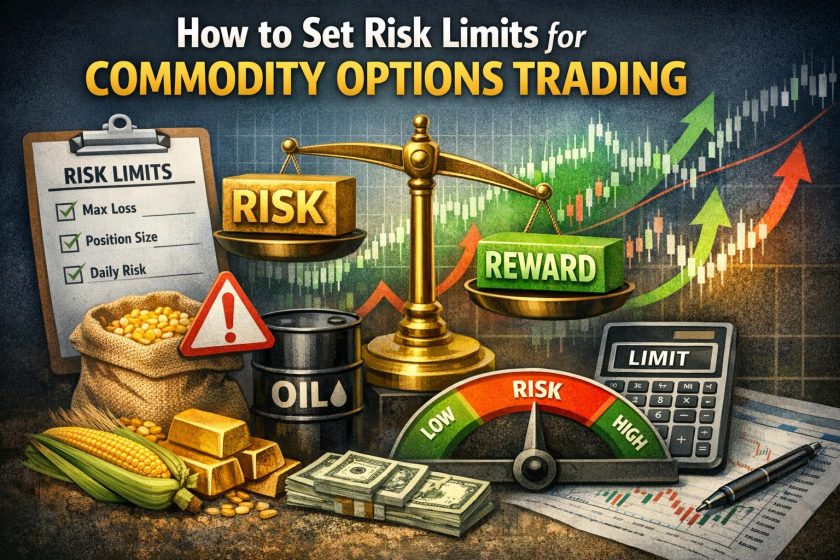
Understanding Risk in Commodity Options Trading
In commodity options trading, risk management is a central element of long-term participation. Commodity markets differ from many equity markets because price movements are often driven by physical supply and demand dynamics, seasonal cycles, macroeconomic variables, and geopolitical developments. These forces can shift rapidly, producing substantial changes in both the underlying commodity prices and the associated option premiums. For traders, the objective is not to eliminate risk but to define, measure, and manage it in a structured manner.
Options provide leverage. A relatively small premium controls a larger notional exposure in the underlying futures contract. While this leverage allows for efficient capital use, it also increases sensitivity to market changes. Without clearly defined limits, a series of adverse trades can significantly impair trading capital. Establishing risk parameters before entering positions allows for disciplined decision-making and reduces the likelihood of reactive trading under pressure.
Commodity options also involve complexities not always present in other asset classes. Contract specifications vary across commodities, including contract size, tick value, and expiration cycles. A standardized and methodical approach to risk ensures that these variations are incorporated into position planning rather than overlooked.
Identifying Risks in Commodity Options
Effective risk limits can only be developed after a thorough understanding of the risks involved. Commodity options trading exposes participants to multiple forms of risk, including price volatility, liquidity constraints, geopolitical and regulatory events, and risks related to time decay and volatility shifts.
Price behavior in commodities is often influenced by factors outside financial markets. Agricultural commodities may be sensitive to weather conditions. Energy prices may respond to infrastructure disruptions or production agreements. Metals may be driven by industrial demand and currency fluctuations. These inputs can introduce sudden and substantial price changes, affecting both option values and margin requirements for certain strategies.
Options introduce additional dimensions of risk beyond movements in the underlying asset. Changes in implied volatility, the passage of time, and interest rates all play a role in determining premium levels. Traders must therefore assess not only directional risk but also exposure to these secondary variables.
Market Volatility
Market volatility represents the degree to which prices fluctuate over a given period. In commodity markets, volatility can expand abruptly due to unexpected news, supply disruptions, or macroeconomic announcements. For option traders, changes in volatility affect both intrinsic and extrinsic value.
An increase in implied volatility typically raises option premiums, even if the underlying price remains stable. Conversely, declining volatility can reduce option values despite favorable movements in the commodity price. Traders holding long options benefit from volatility expansion, while sellers of options may face higher risk if volatility rises unexpectedly.
Risk limits should account for both price risk and volatility risk. This includes analyzing historical volatility ranges and stress testing positions under scenarios of sharp implied volatility changes. Incorporating volatility assumptions into trade planning helps prevent underestimation of potential premium fluctuations.
Liquidity Concerns
Liquidity determines how efficiently a trader can enter or exit positions. In commodity options markets, liquidity varies widely between products and contract months. Highly traded contracts such as crude oil or gold may offer narrow bid-ask spreads, while less active agricultural or specialty commodity options may have wider spreads and thinner order books.
Low liquidity increases transaction costs and execution risk. Slippage between expected and executed prices can materially alter the risk-reward profile of a trade. During periods of market stress, liquidity can deteriorate further, making it difficult to close positions at intended levels.
When setting risk limits, traders should consider average daily volume, open interest, and bid-ask spreads. Limiting position size relative to market liquidity reduces the chance that exiting a position will have a disproportionate price impact. Assessing liquidity under both normal and stressed conditions strengthens overall exposure control.
Geopolitical Risks
Commodities are closely tied to global economic and political developments. Export restrictions, trade policies, sanctions, military conflicts, and regulatory changes can alter supply and demand conditions rapidly. Energy and agricultural products are particularly sensitive to geopolitical developments.
Such risks are often event-driven and may not be predictable through conventional technical analysis. A sudden policy announcement can cause market gaps, where prices move sharply between sessions. Options may reprice immediately, leading to unexpected gains or losses.
Risk management must therefore include scenario planning for geopolitical events. Traders should evaluate the geographic concentration of production and supply chains for the commodities they trade. Incorporating broader macroeconomic monitoring into trading routines allows for proactive adjustments to position exposure.
Strategies for Setting Risk Limits
Developing structured risk limits involves both quantitative measures and procedural rules. These limits define acceptable exposure at the trade level, portfolio level, and time horizon level. The goal is to ensure that no single event or trade jeopardizes overall capital.
Quantitative risk controls typically include maximum loss thresholds, exposure caps, and volatility-based adjustments. Procedural rules might include pre-trade analysis requirements, documentation standards, and regular performance reviews. Together, these elements form a framework that supports consistent decision-making.
Define Maximum Loss Threshold
Establishing a predefined maximum loss is one of the most fundamental components of risk control. This threshold can be applied to individual trades, daily losses, weekly results, or total portfolio drawdowns. The level should be determined relative to total trading capital and long-term objectives.
For long option positions, the maximum loss may be limited to the premium paid. However, strategies involving short options or spreads can carry more complex risk profiles. Naked short options, in particular, may expose traders to substantial theoretical losses if not hedged properly.
Stop-loss orders and contingent orders can help enforce predetermined limits. Nonetheless, traders should recognize that in fast-moving markets, especially those subject to gaps, execution may occur at worse-than-expected prices. Therefore, risk thresholds should incorporate conservative assumptions about slippage.
In addition to per-trade limits, portfolio-level drawdown limits are advisable. For example, a trader may decide to reduce overall exposure if cumulative losses reach a certain percentage of capital within a specified time frame. This mechanism prevents a sequence of unfavorable outcomes from escalating into significant capital impairment.
Diversification
Diversification reduces concentration risk by spreading exposure across different commodities, expiration months, and strategic approaches. Because commodity markets can respond differently to macroeconomic drivers, spreading trades across multiple sectors can reduce overall portfolio volatility.
For instance, exposure to energy, metals, and agriculture may provide varying performance profiles under different economic conditions. However, diversification is most effective when assets are not highly correlated. During systemic crises, correlations between commodities may increase, so risk assessments should not assume constant independence.
Diversification can also be applied through strategy selection. Combining long option positions with defined-risk spreads may balance directional exposure with premium-based income strategies. Careful analysis of overlapping exposures ensures that diversification is genuine rather than superficial.
Position Sizing
Position sizing determines the amount of capital allocated to each trade. Even a strategy with a favorable probability profile can lead to substantial losses if the position size is excessive relative to portfolio value. Conversely, overly small positions may limit meaningful return generation.
A common approach is to allocate a fixed percentage of capital to each trade, adjusting for the estimated risk of loss. For example, trades with higher volatility or wider stop levels may warrant smaller sizes. Position sizing methods may incorporate volatility-based metrics, such as average true range, or option-specific metrics, such as delta-adjusted exposure.
Maintaining consistent sizing rules prevents disproportionate exposure resulting from overconfidence in specific trades. It also simplifies performance analysis by ensuring comparability across positions.
Using Technology for Risk Management
Advances in trading technology have enhanced the capacity to measure and control risk. Modern platforms provide real-time access to pricing data, volatility metrics, margin calculations, and sensitivity analysis. These tools allow traders to evaluate positions continuously rather than relying on delayed reporting.
Effective use of technology requires more than access to data. Traders must integrate analytical outputs into decision-making routines. Risk dashboards that display aggregate exposure, margin utilization, and scenario projections can provide a broader perspective than isolated trade analysis.
Utilizing Analytical Tools
Options analytics often focus on the Greeks, which quantify the sensitivity of option prices to various factors. Delta measures directional price sensitivity, gamma reflects the rate of change of delta, theta estimates time decay, and vega indicates sensitivity to changes in implied volatility. Rho measures interest rate sensitivity.
Understanding these metrics enables more precise exposure management. For example, monitoring aggregate delta across the portfolio provides insight into directional bias, while tracking vega exposure highlights vulnerability to volatility shifts. Gamma analysis can reveal potential nonlinear risk, particularly near expiration.
Scenario analysis tools allow traders to project portfolio performance under simulated price moves or volatility changes. Stress testing across extreme yet plausible scenarios enhances preparedness for unexpected market conditions.
Automation and Alerts
Automated systems can support enforcement of risk limits. Price alerts, volatility alerts, and margin notifications ensure that significant changes do not go unnoticed. Automated order placement based on predefined criteria can assist in maintaining discipline, particularly in rapidly moving markets.
Algorithmic features may also enable systematic rebalancing when exposure exceeds target thresholds. For instance, if portfolio delta surpasses a predetermined level due to market movement, hedging transactions can be triggered automatically. This reduces reliance on manual intervention and limits the influence of cognitive bias.
However, automation should be tested thoroughly to avoid operational errors. Clear parameters and contingency plans are essential to prevent unintended trade execution.
Ongoing Monitoring and Adjustment
Risk management in commodity options trading is an ongoing process rather than a static configuration. Market conditions evolve, implied volatility regimes change, and personal financial circumstances may shift over time. Regular review of risk limits ensures alignment with current objectives and market realities.
Periodic evaluation of trading performance provides empirical data for refining limits. Metrics such as average drawdown, win-loss ratio, and volatility of returns can inform adjustments to position sizing or maximum loss thresholds. Reviewing instances where limits were breached can reveal weaknesses in execution or planning.
Maintaining detailed trade records enhances accountability and facilitates systematic improvement. Documentation of rationale, risk parameters, and exit decisions supports objective analysis rather than reliance on memory.
Conclusion
Commodity options trading offers opportunities for capital deployment across diverse markets influenced by global economic forces. The same characteristics that create opportunity also introduce substantial variability and potential for loss. A structured framework for setting and maintaining risk limits is therefore essential.
By identifying key sources of risk, including volatility, liquidity, and geopolitical exposure, traders can design appropriate safeguards. Techniques such as defining maximum loss thresholds, employing disciplined position sizing, and diversifying across commodities and strategies contribute to capital preservation. The integration of analytical tools and automation further strengthens the ability to monitor and respond to evolving market conditions.
Risk management should be treated as a continuous discipline rather than a preliminary step before trading. Through consistent evaluation and adjustment, traders can align their exposure with both market dynamics and personal objectives, supporting sustainable participation in commodity options markets.
This article was last updated on: July 9, 2026