How to Evaluate Liquidity Before Entering Commodity Options Trades
By : Admin -
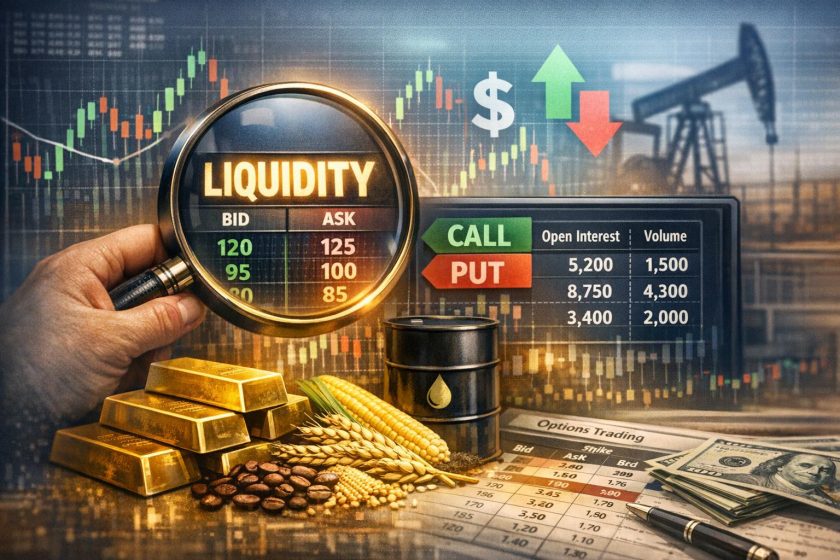
Understanding Liquidity in Commodity Options
Commodity options trading requires a thorough understanding of liquidity, which refers to how easily an asset can be bought or sold in the market without significantly affecting its price. In the context of options on commodities such as crude oil, natural gas, gold, corn, or soybeans, liquidity influences not only transaction costs but also strategy selection, risk management, and overall market participation. Unlike the underlying futures or physical commodities, options introduce additional dimensions such as strike price, expiration date, and implied volatility. These factors make liquidity assessment more complex and more important.
Liquidity is not a static characteristic. It varies across commodities, across expiration months, and even across strike prices within the same expiration. A near-term at-the-money crude oil option may be highly liquid, while a far out-of-the-money contract for a distant expiration month may trade infrequently. Understanding these distinctions can help traders avoid unintended costs and execution challenges.
Why Liquidity Matters
Liquidity plays a central role in trading efficiency and cost management. Traders in commodity options often operate with specific objectives, such as hedging price risk, generating income, or speculating on volatility. In each case, liquidity directly influences the feasibility and effectiveness of the chosen approach.
Reduced Transaction Costs: In liquid markets, the difference between the bid price and the ask price—known as the bid-ask spread—tends to be narrower. A narrow spread allows traders to enter and exit positions at prices closer to the theoretical or mid-market value of the contract. In contrast, a wide spread effectively increases trading costs, as traders may need to accept less favorable pricing to execute their orders. Over time, especially for active traders, these costs can significantly affect performance.
Easier Execution: High liquidity means there are many buyers and sellers participating in the market at various price levels. This depth allows traders to execute larger orders without causing substantial price movement. For institutional participants or commercial hedgers, the ability to move significant volume without altering market prices is particularly important. Even for smaller traders, execution speed and reliability are enhanced in liquid markets.
Accurate Price Discovery: A liquid market typically incorporates information more efficiently. Numerous trades across various price levels contribute to a pricing process that reflects the aggregate expectations of market participants. In contrast, in thinly traded options contracts, a single trade can disproportionately influence the quoted price. Reliable price discovery is essential for evaluating implied volatility, gauging relative value across strikes, and managing portfolio risk.
Key Indicators of Liquidity
Assessing liquidity in commodity options requires examining several measurable indicators. While no single metric provides a complete picture, a combination of volume, open interest, and bid-ask spreads can offer meaningful insight.
Volume: Trading volume refers to the number of contracts traded during a specific period, typically a trading day. Higher daily volume often indicates greater market activity and stronger liquidity. When evaluating an option contract, comparing current volume to historical averages can help determine whether liquidity is consistent or concentrated during particular periods, such as around major economic releases or seasonal events.
It is also important to examine volume across related strikes and expirations. A trader considering a multi-leg strategy, such as a spread or straddle, should ensure that each component leg has adequate volume. Otherwise, the strategy may be difficult to execute at intended price levels.
Open Interest: Open interest represents the total number of outstanding contracts that have not been closed or exercised. Unlike volume, which measures trading activity over a defined period, open interest reflects the cumulative number of positions still active. A rising open interest generally suggests that new participants are entering the market, which may enhance liquidity. Conversely, declining open interest can signal reduced engagement and potentially lower liquidity.
Open interest is particularly useful in commodity options because it can indicate which strike prices and expirations are attracting the most attention. Contracts with consistently high open interest are typically easier to trade than those with only a small number of outstanding positions.
Bid-Ask Spread: The bid-ask spread is a direct and practical measure of liquidity. A tight spread indicates that buyers and sellers are closely aligned in their valuation of the option. A wide spread may suggest limited competition among market makers or low trading interest. For traders, monitoring the spread in real time is often more informative than relying solely on volume or open interest data.
Liquidity Across Strikes and Expirations
Commodity options are organized by expiration month and strike price, creating a matrix of available contracts. Liquidity is rarely uniform across this matrix. Typically, the most actively traded contracts are those that are near expiration and have strike prices close to the current underlying futures price. These contracts are often referred to as at-the-money options.
As options move further out-of-the-money or further into the future, trading activity tends to decline. Deep out-of-the-money options may appeal to traders seeking leveraged exposure or hedging against extreme price movements, but these contracts can exhibit wider spreads and lower volume. Similarly, long-dated options may have lower liquidity if market participants focus their attention on shorter-term price movements.
Traders should evaluate liquidity not only at the individual contract level but also at the portfolio strategy level. For example, calendar spreads require liquidity in multiple expiration months, while vertical spreads require efficient pricing across two or more strikes within the same month.
The Role of Market Makers
Market makers play a central role in maintaining liquidity in commodity options. These participants continuously quote bid and ask prices and stand ready to buy or sell contracts. By providing two-sided markets, market makers help reduce spreads and ensure that traders can execute orders in a timely manner.
Market makers manage their own risk through hedging strategies, often using the underlying futures contracts or related options. Their willingness to provide liquidity depends on factors such as market volatility, transaction costs, and risk exposure. During periods of heightened volatility, market makers may widen bid-ask spreads to compensate for increased uncertainty, effectively reducing liquidity even if trading volume remains elevated.
Understanding the role of market makers helps explain why liquidity can fluctuate throughout the trading day or in response to major events. For example, liquidity may decrease temporarily around significant economic announcements if market participants hesitate to commit capital until new information is incorporated into prices.
Impact of Volatility on Liquidity
Volatility and liquidity are closely connected in commodity options markets. Moderate increases in volatility can attract trading activity, as participants seek opportunities or adjust hedges. However, extreme volatility may have the opposite effect, widening spreads and making execution more costly.
In commodity markets, volatility can be driven by factors such as supply disruptions, geopolitical developments, weather conditions, and macroeconomic policy changes. Options pricing reflects this volatility through changes in implied volatility levels. When implied volatility rises sharply, option premiums increase, and uncertainty about fair value may discourage participants from quoting tight spreads.
Traders should consider how prevailing volatility conditions may affect liquidity before entering positions. Evaluating historical patterns around similar events can provide insight into potential execution challenges.
Considering Market Participants
The number and diversity of market participants significantly influence liquidity. Commodity options markets typically include commercial hedgers, institutional investors, proprietary trading firms, hedge funds, and retail traders. Each group contributes differently to overall market activity.
Commercial hedgers, such as producers and consumers of commodities, use options to manage price risk. Their participation often increases liquidity in specific contracts tied to production cycles or seasonal patterns. Institutional investors and hedge funds may focus on directional or volatility-based strategies, contributing additional trading volume across various strikes and expirations.
Retail traders often gravitate toward more standardized, high-volume contracts. Their aggregate activity can meaningfully enhance liquidity in widely followed commodities. A market with participation from multiple categories of traders is generally more resilient and better able to maintain liquidity under varying conditions.
Using Technology and Platforms
Modern trading platforms offer tools that allow traders to evaluate liquidity in real time. These platforms typically display live bid-ask quotes, recent trades, volume, open interest, and depth-of-market information. Depth-of-market data shows the quantity of buy and sell orders resting at different price levels, offering insight into the market’s capacity to absorb larger trades.
Advanced analytics may also include implied volatility surfaces, historical volume trends, and comparative metrics across strikes and expirations. By integrating these tools into their analysis, traders can identify contracts that align with their liquidity requirements.
Algorithmic order types, such as limit orders or spread orders, can further improve execution quality in liquid markets. In less liquid environments, traders may need to adjust order sizes, use staged entries, or allow additional time for execution.
Liquidity and Risk Management
Liquidity plays an essential role in risk management. A position that cannot be exited efficiently may expose the trader to additional market risk. In commodity options, rapid price movements in the underlying futures can significantly alter the value of an option position. If liquidity deteriorates during these movements, closing or adjusting the position may become costly.
Stress testing strategies under different liquidity scenarios can enhance preparedness. For example, traders might evaluate how a widening of bid-ask spreads or a decline in trading volume would influence their ability to rebalance a portfolio. Incorporating liquidity considerations into position sizing decisions can help mitigate potential challenges.
Conclusion
Evaluating liquidity is a fundamental step in commodity options trading. Liquidity affects transaction costs, execution quality, price discovery, and risk management. By examining indicators such as trading volume, open interest, and bid-ask spreads, traders can assess whether a specific contract meets their operational needs.
Liquidity is influenced by strike selection, expiration month, market volatility, and the composition of market participants. It can vary over time and in response to economic or geopolitical developments. Through careful analysis and the use of modern trading platforms, traders can monitor these dynamics and adapt their strategies accordingly.
A consistent focus on liquidity enables more efficient market participation and supports disciplined trading decisions in the complex environment of commodity options.
This article was last updated on: May 29, 2026