How to Select Expiry Dates in Commodity Options Based on Trade Thesis
By : Admin -
Understanding Expiry Dates in Commodity Options
Selecting the appropriate expiry date in commodity options is a structural decision that shapes the entire trade. Unlike choosing a strike price, which determines the price level at which rights may be exercised, the expiry date determines when those rights cease to exist. In commodity markets—where supply cycles, macroeconomic influences, seasonality, and geopolitical events intersect—time is often as important as price.
Expiry selection is therefore not a secondary parameter. It directly influences option pricing, sensitivity to volatility, liquidity conditions, margin efficiency, and the probability that a trade thesis has sufficient time to develop. An option that is correctly structured in price but poorly aligned in time may fail to realize its intended potential, even if the underlying commodity eventually moves in the anticipated direction.
Consider the Trade Thesis
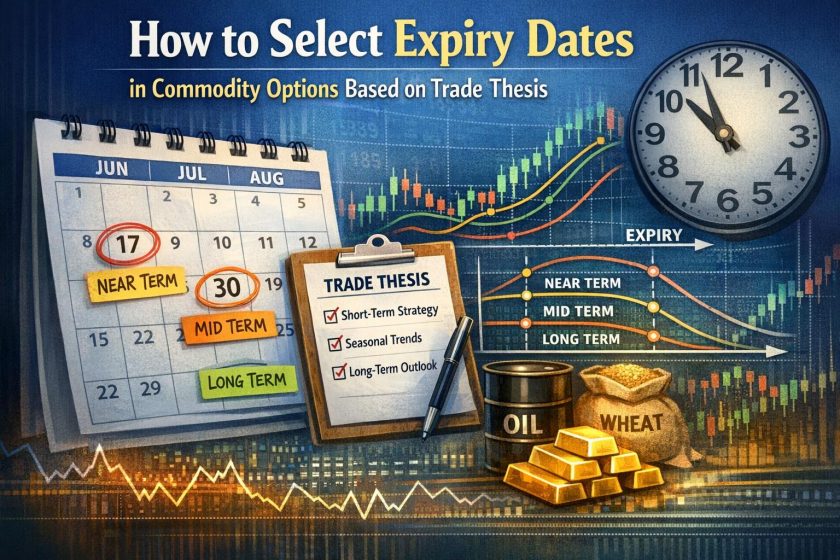
When choosing an expiry date, the central reference point should be the trade thesis. A thesis defines the expected price movement, the catalyst driving that movement, and the anticipated timeline. Without a clearly defined time horizon, the decision between near-term and longer-dated expiries becomes speculative rather than analytical.
Commodity markets often respond to identifiable triggers. These may include crop reports, weather developments, inventory data, central bank policy shifts, shipping constraints, or regulatory changes. Each catalyst has a distinct time horizon. For example, a weather forecast affecting crop yields may influence prices rapidly over several weeks, whereas structural underinvestment in mining capacity may unfold over several years.
Matching expiry to thesis duration allows the position to reflect the logic of the trade. If a trader expects price adjustment within a defined window of time, selecting an expiry that extends meaningfully beyond that window may dilute capital efficiency. Conversely, choosing an expiry that precedes the expected catalyst may cause the position to decay before the thesis is validated.
Precision in Time Framing
A common analytical approach involves estimating the time required for three phases: catalyst emergence, market recognition, and price adjustment. Markets do not always price fundamental developments immediately. In commodities, inventory data might be released promptly, yet broader supply rebalancing may take several months.
Therefore, expiry dates should often incorporate a margin beyond the anticipated catalyst window. This allows for gradual market repricing and reduces sensitivity to short-term volatility unrelated to the core thesis. Such precision enhances consistency in execution.
Short-Term vs. Long-Term Expiries
For those anticipating short-term market events, near-term options can offer targeted exposure. Monthly inventory reports from energy agencies, agricultural yield updates, or near-term weather shifts frequently produce concentrated volatility. In such cases, shorter expiries can efficiently express a defined directional expectation.
Short-term contracts typically exhibit greater liquidity in front-month commodity options, which can translate into narrower bid-ask spreads and more efficient trade execution. However, this convenience carries structural consequences: time decay accelerates rapidly, and price movements must materialize promptly for the trade to maintain value.
By comparison, if a thesis implies a longer-term market trend, such as a prolonged supply disruption or sustained demand growth, longer-dated options may provide more flexibility. Extended expiries allow the underlying commodity more time to reflect structural developments. They also exhibit slower daily time decay in their early life, affording greater tolerance for interim price fluctuations.
Long-dated options are often used for strategic positioning rather than tactical trading. Institutional participants may favor them to hedge production exposure or to gain multi-quarter leverage to macroeconomic themes. Although their premiums are higher in absolute terms, they can deliver a smoother risk profile over time.
Risk Tolerance and Capital Allocation
Risk tolerance is integral to expiry selection. Short-term options tend to display higher gamma, meaning their sensitivity to price changes increases as expiration approaches. This can generate swift gains if the underlying moves favorably, but it can also amplify losses in a compressed timeframe.
Traders with lower tolerance for short-duration price swings may prefer longer expiries, which distribute risk exposure across a broader time horizon. In contrast, participants seeking tactical exposure around scheduled announcements may accept the sharper risk-reward profile of expiring contracts.
Capital allocation also interacts with expiry decisions. Longer-dated options demand higher upfront premium payments, reducing position size for a fixed capital budget. Shorter-term options, while cheaper per contract, may require frequent rollovers if the thesis extends beyond their expiry. Over time, repeated rolling can accumulate transaction costs and slippage, which should be incorporated into strategic planning.
Risk Tolerance and Volatility
Commodity markets are characterized by periodic surges in volatility. Energy contracts may react sharply to policy changes, metals markets may respond to industrial data, and agricultural commodities can move significantly in response to unforeseen weather developments.
Short-dated options reflect volatility more acutely in their premiums. When implied volatility rises, near-term options can become relatively expensive compared to their historical baseline. Traders must assess whether the implied volatility embedded in the premium justifies the expected movement within the limited time frame remaining.
Longer-dated options distribute volatility risk over time, often resulting in more stable pricing dynamics. Their exposure to volatility changes, known as vega sensitivity, is typically higher than that of near-term contracts. Consequently, expiry selection should account for whether the thesis depends primarily on directional movement or also on anticipated changes in implied volatility.
Evaluating Market Volatility
Evaluating market volatility requires examining both historical and implied measures. Historical volatility provides context for how much a commodity has fluctuated in past periods. Implied volatility, derived from current option prices, reflects market expectations of future movement.
If implied volatility significantly exceeds historical norms without clear justification, shorter expiries may be disproportionately priced. In contrast, during periods of subdued implied volatility, longer-dated options may offer relatively favorable entry conditions for structural positions.
Seasonal volatility patterns are particularly relevant in commodities. Agricultural markets, for instance, often experience heightened volatility around planting and harvest periods. Energy markets may exhibit predictable seasonal consumption trends. Aligning expiry not only with price expectation but also with volatility cycles can enhance structural alignment.
Time Decay Implications
All option positions are subject to time decay, or theta. Time decay represents the erosion of extrinsic value as expiration approaches. For options nearing maturity, this decay accelerates markedly. As a result, short-dated expiries require more immediate and decisive movement to offset the decline in time value.
Time decay is not uniform across all expiries. Longer-dated options experience slower initial theta decay, which increases as the contract moves closer to expiration. This property enables longer-term holders to withstand temporary stagnation in price more comfortably than traders in front-month contracts.
The interaction between time decay and volatility also matters. In high-volatility periods, extrinsic values are elevated, and decay can be substantial in absolute terms. Managing expiry selection with an understanding of theta dynamics helps avoid scenarios in which a correct market view fails to translate into profit due to insufficient timing precision.
When evaluating potential positions, traders may simulate time decay trajectories under varying price scenarios. Such modeling clarifies how long the thesis can remain inactive before erosion materially reduces the trade’s probability of success.
Liquidity and Market Structure Considerations
Commodity options exhibit varying liquidity across different tenors. Front-month expiries usually have greater trading volume, tighter spreads, and more active market participation. This tends to facilitate entry and exit efficiency.
Longer-dated contracts may have thinner liquidity. Wider spreads can increase execution costs, and large positions may require staged transactions. In less liquid maturities, price quotations may shift quickly as orders are placed, particularly in niche commodities.
Futures term structure also influences option expiry decisions. Commodities frequently trade in contango or backwardation. The slope of the futures curve affects both option pricing and rolling strategies. If the trade thesis involves rolling exposure across contract months, the shape of the forward curve may amplify or offset gains.
Understanding how expiry aligns with the underlying futures contract is also important. Commodity options are typically written on specific futures months, not the spot commodity. Therefore, expiry selection inherently involves choosing exposure to a particular segment of the futures curve.
Practical Example
Consider a trader analyzing seasonal dynamics in the soybean market. Historical data may indicate that prices tend to rise between late planting season and harvest due to yield uncertainty. If the trader anticipates a moderate supply reduction becoming visible by mid-season, a medium-term expiry aligned with that period can improve alignment between time horizon and expected price realization.
A very short-dated option might expire before yield data confirm supply constraints, leading to value decay. Conversely, a significantly longer-dated expiry extending well beyond harvest may introduce unnecessary exposure to unrelated macroeconomic variables, diluting the efficiency of the trade.
The same logic applies to energy markets. Suppose refinery maintenance schedules indicate tightening gasoline supply during a defined window. An expiry selected to capture that window, while allowing modest extra time for price transmission, anchors the option to the structural driver rather than to incidental volatility.
Aligning Expiry Dates with Macro Events
Macroeconomic events can exert substantial influence on commodity pricing. Central bank decisions affect currency valuations, which in turn influence globally traded commodities priced in U.S. dollars. Trade policy changes can alter the flow of agricultural exports. International negotiations may impact production quotas in energy markets.
Aligning expiry dates with anticipated macro events requires understanding both event timing and market reaction dynamics. Certain announcements produce immediate price adjustments, whereas others generate a sequence of market responses over weeks or months.
Economic calendars serve as planning tools for expiry selection. If a thesis relies on a central bank rate decision scheduled in three months, choosing an option expiring shortly after that decision may efficiently capture associated volatility. However, if policy impact is expected to unfold gradually through capital flows and production adjustments, a longer tenor may be warranted.
Unexpected events introduce complexity. While expiry selection cannot anticipate unforeseen developments, longer-dated options inherently provide more resilience against short-term disruptions, as they offer extended time for recovery or thesis validation.
Strategic Integration of Factors
Selecting expiry dates in commodity options requires the integration of several interconnected factors: clarity of thesis, expected timeframe, volatility conditions, liquidity, and tolerance for time decay. Treating expiry as a quantitative variable—rather than a default selection—encourages discipline in trade construction.
Professional market participants often approach expiry choice systematically. They may begin with the anticipated catalyst window, add a predefined time buffer, compare pricing across adjacent maturities, evaluate implied volatility skew, and assess liquidity considerations before finalizing the structure.
This method reduces the risk of misalignment between market expectation and instrument design. It also facilitates consistent post-trade evaluation. If a trade underperforms, reviewing whether expiry duration matched the actual market timeline can yield instructive insights.
Conclusion
Expiry selection in commodity options defines the temporal boundaries of opportunity and risk. It shapes premium cost, sensitivity to price and volatility, exposure to time decay, and alignment with structural market forces. Short-term expiries may provide precision and liquidity around immediate catalysts, while longer-dated contracts can accommodate extended trends and gradual adjustments.
A disciplined approach anchors expiry decisions to the trade thesis, measured assessment of volatility, and clearly defined risk parameters. By aligning timing structures with market logic, participants enhance the probability that commodity price movement—when it occurs—develops within the life span of the option position.
This article was last updated on: June 25, 2026