Commodity Options Position Sizing for Defined-Risk Strategies
By : Admin -
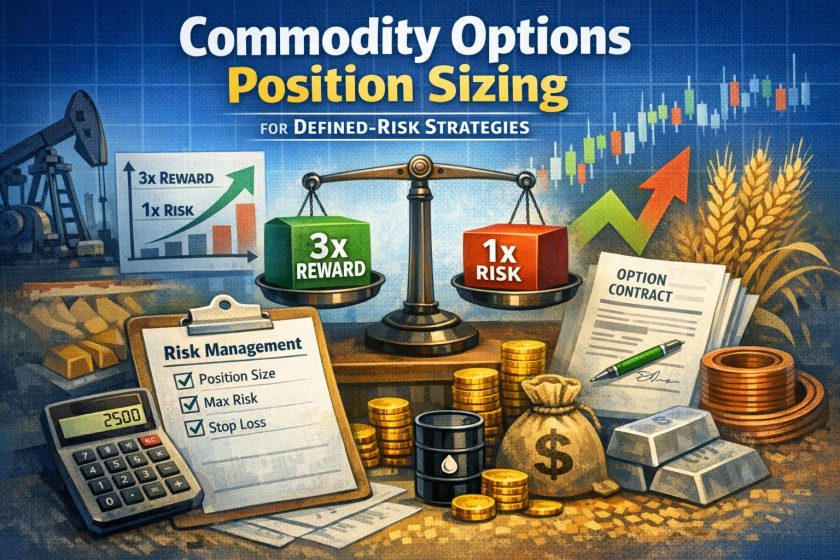
Understanding Commodity Options Position Sizing
Commodity options trading attracts investors and professional market participants because it offers structured exposure to energy, metals, agricultural products, and other physical goods without requiring direct ownership. Options provide flexibility in expressing directional views, hedging existing exposures, or constructing income strategies. However, without disciplined risk controls, option positions can expose a portfolio to outcomes that exceed acceptable limits.
Position sizing is central to maintaining defined risk in commodity options trading. It determines how much capital is allocated to a specific trade and directly influences portfolio volatility, drawdowns, and long-term performance. Even when a strategy has a statistical advantage, improper position sizing can undermine results. When used within a defined-risk framework, position sizing ensures that each trade contributes proportionately to overall portfolio objectives rather than dominating or distorting them.
What Are Defined-Risk Strategies?
Defined-risk strategies are trading approaches in which the maximum potential loss is known at the time the trade is initiated. In the context of options, this characteristic is most commonly associated with purchasing options outright or constructing spreads that cap downside exposure. Unlike selling naked options, where potential losses may be theoretically unlimited, defined-risk structures provide clarity regarding worst-case outcomes.
For example, when purchasing a call or put option, the most that can be lost is the premium paid, along with transaction costs. In debit spreads, where one option is purchased and another is sold at a different strike, the maximum loss is confined to the net premium paid. Because these strategies outline clear loss boundaries, they are widely used by traders seeking exposure to commodity price movements without assuming open-ended liability.
Defined-risk strategies contribute to portfolio stability in several ways. They simplify planning because losses can be quantified before entry. They assist in capital allocation decisions by allowing traders to compare risk-adjusted opportunities. They also reduce the likelihood that a single large adverse move in commodities such as crude oil or natural gas will compromise long-term objectives.
Key Elements of Commodity Options
Commodity options are derivatives tied to futures contracts. Purchasing an option on crude oil, gold, or corn typically grants the right, but not the obligation, to enter a corresponding futures contract at a specified price. Several structural components define the economics of these instruments.
Strike Price: The strike price is the predetermined level at which the option holder may buy or sell the underlying futures contract. It determines whether the option is in the money, at the money, or out of the money. The relationship between current market price and strike price significantly influences the option’s premium and its sensitivity to price changes.
Expiration Date: Commodity options are time-sensitive contracts. The expiration date determines the final opportunity to exercise or offset the option. As expiration approaches, time value decays, a phenomenon known as theta decay. This decay rate accelerates in the final weeks before expiration, which has direct implications for position sizing and trade duration.
Premium: The premium is the price paid to acquire the option. It reflects intrinsic value, time value, market volatility, and supply-demand dynamics. In defined-risk strategies involving option purchases, the premium represents the maximum theoretical loss per contract. Understanding how premium behaves under different volatility and price scenarios is critical when determining appropriate position size.
Why Position Sizing Matters in Commodity Markets
Commodity markets are often characterized by pronounced volatility driven by geopolitical developments, weather patterns, macroeconomic cycles, and shifts in global supply and demand. Futures contracts typically represent substantial notional value. For instance, a single crude oil futures contract may control tens of thousands of dollars’ worth of the underlying product. Options on these contracts inherit that leverage.
Because of this embedded leverage, small movements in the underlying commodity can produce large percentage changes in option value. If a trader purchases too many contracts relative to account size, even defined-risk positions can trigger sizeable drawdowns. While the maximum loss per contract may be limited to the premium, the aggregate premium across multiple contracts can represent a substantial portion of trading capital.
Proper position sizing aligns each trade’s potential loss with overall portfolio tolerance. It ensures that a sequence of losing trades does not substantially impair capital. It also supports consistent compounding over time by preventing overconcentration in a single idea or commodity sector.
Calculating Position Size
Determining position size involves integrating personal risk tolerance, market structure, and strategy design. The calculation begins with identifying the maximum acceptable risk per trade. Many disciplined traders risk between 1% and 2% of total trading capital on a single position, though the specific percentage depends on objectives, experience, and drawdown tolerance.
Assume a trading account contains $50,000. If the trader chooses to risk 2% per trade, the maximum allowable loss equals $1,000. If a gold call option costs $2.50 per contract and each contract represents 100 ounces, the cash premium equals $250 per contract (before fees). Since the maximum loss per contract is $250, the trader could theoretically purchase up to four contracts while staying within the $1,000 limit.
Position size = Maximum dollar risk per trade ÷ Premium per contract
This formula provides a starting point. However, contract specifications must be carefully reviewed, as commodity multipliers vary widely. Agricultural contracts, energy contracts, and metals contracts may each have distinct lot sizes and tick values, affecting effective exposure.
In addition to premium cost, traders should account for liquidity and slippage. Thinly traded options may have wide bid-ask spreads, increasing effective cost and altering true risk-reward calculations. Position sizing should be based on realistic execution prices rather than theoretical midpoints.
Volatility and Its Impact on Position Sizing
Implied volatility plays a central role in option pricing. When implied volatility is high, premiums rise, increasing the capital required per contract. If a trader rigidly maintains a percentage-based risk cap, elevated premiums automatically reduce the number of contracts that can be purchased. This dynamic creates a natural stabilizing mechanism within defined-risk position sizing.
Changes in volatility also affect the probability distribution of potential outcomes. Higher volatility often implies larger expected price swings. While defined-risk trades cap losses, higher volatility environments can increase the likelihood that the full premium will be lost. Traders may therefore choose to reduce percentage risk during unusually volatile periods, particularly in commodities that are influenced by geopolitical or weather-driven events.
Conversely, lower implied volatility reduces premium cost but may also compress potential price movement expectations. Position sizing decisions should be evaluated alongside volatility conditions to ensure that trade expectations remain aligned with statistical probabilities.
Portfolio-Level Risk Considerations
Position sizing should not occur in isolation. Commodity markets are often interconnected. For example, crude oil and heating oil share economic drivers, while corn and soybeans can be influenced by similar agricultural factors. Holding multiple positions that are highly correlated effectively magnifies risk beyond what single-trade calculations suggest.
To address this, traders may implement portfolio-level exposure limits by sector. If a trader has already allocated 4% of capital to energy-related options, additional energy trades may require reduced sizing or may be deferred altogether. This approach prevents concentrated drawdowns resulting from a sector-wide adverse movement.
Correlation analysis also informs diversification. By distributing defined-risk positions across commodities influenced by differing macroeconomic variables, traders can reduce aggregate portfolio volatility without necessarily reducing total invested capital.
Adjustments and Active Management
Defined-risk does not imply passive management. While maximum loss is predetermined, traders may choose to exit positions before expiration if market conditions change. For example, if a purchased option loses 50% of its value and the underlying technical thesis is invalidated, an early exit can preserve capital for other opportunities.
Conversely, if a position appreciates significantly, partial profit-taking can rebalance exposure. Reducing contract quantity after gains maintains risk discipline and prevents a profitable trade from becoming disproportionately large relative to portfolio size.
Some traders use trailing thresholds or predefined percentage rules to standardize adjustments. Although these practices vary, they share a common objective: maintaining consistency in exposure relative to capital.
Benefits of Defined-Risk Position Sizing
Defined-risk position sizing contributes to several structural advantages in commodity trading. The first is limited downside. Knowing the maximum possible loss before entering a trade simplifies planning and reduces uncertainty in worst-case projections.
Another benefit is capital efficiency. Rather than committing large sums to margin requirements associated with futures contracts, traders can use options premiums strategically, maintaining liquidity for additional trades or risk mitigation.
Defined-risk sizing also enhances performance consistency. By standardizing exposure, traders can better evaluate the statistical characteristics of their strategies over time. Outlier outcomes become less likely to dominate long-term results.
Finally, maintaining predefined risk allocations supports objective decision-making. With parameters already established, position size becomes a function of policy rather than impulse.
Practical Tools for Risk Assessment
Options analytics platforms provide scenario modeling for commodity options. These tools estimate potential profit and loss under varying price, volatility, and time assumptions. By reviewing payoff diagrams and sensitivity measures such as delta and theta, traders can better understand how position size interacts with market conditions.
Risk aggregation software can display total open risk across a portfolio, grouping positions by commodity, expiration, or directional bias. Such tools are particularly useful when holding multiple defined-risk trades simultaneously.
Stress-testing methods can also be applied manually. Traders may calculate projected outcomes under extreme but plausible commodity price moves to evaluate whether total premium exposure remains acceptable under adverse conditions.
Conclusion
Commodity options offer structured methods for participating in price movements across global raw materials markets. While defined-risk strategies limit maximum loss per contract, overall exposure is determined by position size. Careful sizing ensures that each trade aligns with portfolio objectives, capital constraints, and volatility conditions.
By calculating maximum acceptable risk, understanding contract specifications, incorporating volatility considerations, and evaluating portfolio correlations, traders can construct disciplined commodity options strategies. Defined-risk positioning does not eliminate uncertainty, but it establishes a measurable framework within which uncertainty can be managed systematically.
This article was last updated on: July 2, 2026