Bid-Ask Spreads in Commodity Options and Their Impact on Execution
By : Admin -
Understanding Bid-Ask Spreads in Commodity Options
In the world of commodity options, the bid-ask spread plays a central role in determining how trades are executed and at what cost. Commodity options are derivative contracts that grant the holder the right, but not the obligation, to buy or sell an underlying commodity at a predetermined price within a specific time frame. Unlike spot markets where prices may appear straightforward, the pricing of options introduces additional layers of complexity that are reflected in the difference between buying and selling prices.
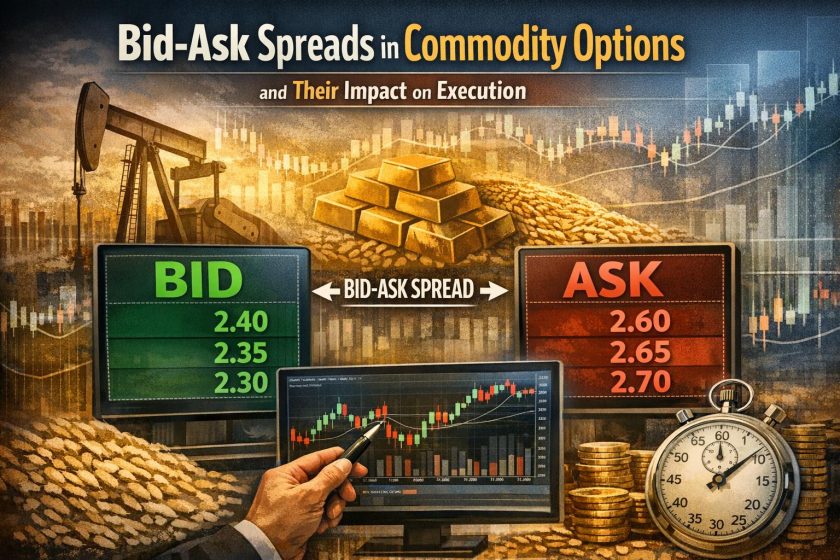
The bid price represents the highest price a participant in the market is currently willing to pay for a particular option contract. Conversely, the ask price reflects the lowest price at which another participant is willing to sell that contract. The numerical difference between these two prices is referred to as the bid-ask spread. This spread is not arbitrary; it compensates market participants for risk, operational costs, and the provision of liquidity.
Understanding the bid-ask spread is fundamental because it represents an immediate and measurable transaction cost. When a trader purchases an option at the ask price and then immediately sells it at the bid price, the spread constitutes a direct loss. Over time, especially for active traders, these costs can accumulate and significantly influence overall performance.
Structural Characteristics of Commodity Options Markets
Commodity options differ from equity options in several structural respects, and these distinctions can influence bid-ask spreads. Commodities such as crude oil, gold, natural gas, wheat, and corn trade through futures exchanges, and options are typically written on futures contracts rather than on the physical commodities themselves. As a result, spreads in commodity options are shaped by the liquidity of the underlying futures market, delivery mechanisms, storage costs, and seasonality.
Market participants in commodity options often include producers, consumers, hedgers, institutional investors, proprietary trading firms, and designated market makers. Each category of participant brings different objectives and risk tolerances. Producers may use options to hedge expected output, while refiners might protect against rising input costs. Speculators may seek to profit from directional price movements or volatility shifts. The mix of participants can affect order flow patterns, which in turn influence the tightness or width of spreads.
The trading infrastructure also shapes spreads. Electronic trading platforms facilitate rapid quote updates and allow multiple liquidity providers to compete. In highly competitive and electronically efficient markets, bid-ask spreads tend to narrow because market makers respond quickly to order imbalances. In contrast, in less active contracts with lower trading volume, quotes may update less frequently, leading to wider spreads.
Factors Influencing Bid-Ask Spreads
Several variables affect the size of bid-ask spreads in commodity options markets. One of the most important is market liquidity. Liquidity refers to the ability to buy or sell contracts without causing significant price disruption. In heavily traded commodities such as crude oil or gold, large numbers of buyers and sellers participate throughout the trading day. Because there is frequent interaction between supply and demand, the gap between bid and ask prices is often relatively narrow. Market makers face less risk of holding unwanted inventory for long periods, allowing them to quote tighter spreads.
In contrast, options on less actively traded commodities or far-dated expiration months may show significantly wider spreads. When fewer participants are willing to trade, market makers assume greater risk by standing ready to buy and sell. They widen spreads to compensate for potential adverse price movements while holding inventory.
Volatility is another major determinant. Option prices are highly sensitive to expected volatility in the underlying commodity. During periods of heightened uncertainty, such as geopolitical disruptions affecting oil supply or extreme weather threatening agricultural yields, implied volatility can increase sharply. Rising volatility increases the uncertainty of fair value estimates and exposes market makers to greater directional and gamma risk. To offset this uncertainty, they often quote wider spreads.
Transaction costs borne by intermediaries also contribute to spreads. These include exchange fees, clearing fees, technology costs, capital requirements, and regulatory compliance expenses. Market makers must recover these operational costs through the spread. In competitive markets, spreads may closely approximate marginal costs, while in less competitive environments, they may remain wider.
Order size influences spreads as well. Large orders may exceed displayed market depth, requiring execution across multiple price levels. When liquidity providers anticipate that large trades could move the market, they may widen spreads in anticipation of inventory imbalances. Smaller retail-sized orders typically encounter narrower spreads, provided sufficient liquidity exists near the top of the order book.
Time to expiration plays a role in spread determination. Near-term options often trade more actively and exhibit narrower spreads than long-dated contracts. Distant expiration options involve greater uncertainty regarding supply-demand dynamics, seasonality, and macroeconomic conditions, leading to broader quoting ranges.
Role of Market Makers and Liquidity Providers
Market makers serve as intermediaries that continuously post bid and ask quotes. Their function is to provide liquidity by standing ready to transact even when other market participants are not immediately present on the opposite side of a trade. In doing so, they assume inventory risk. If they purchase options at the bid price, they may later struggle to sell them quickly without reducing the price. Conversely, when selling at the ask price, they may need to repurchase contracts at higher levels if market conditions change.
The bid-ask spread compensates market makers for inventory risk, price volatility, and adverse selection. Adverse selection arises when traders possess superior information regarding impending market movements. For example, if a trader anticipates a major supply disruption and aggressively buys call options, a market maker selling those options risks substantial losses if prices surge. To protect against such informational disadvantages, liquidity providers incorporate a margin of safety into spreads.
Competition among market makers can narrow spreads. When multiple participants seek to capture trading volume, they may reduce quoted spreads to attract order flow. Electronic trading systems facilitate rapid repricing, enabling market makers to adjust quotes in response to changing volatility or delta exposure. However, during periods of market stress, some liquidity providers may withdraw or reduce activity, resulting in wider spreads.
Impact on Execution and Trading Strategies
The size of the bid-ask spread directly affects execution prices and influences a wide range of trading strategies. For traders who utilize short-term approaches such as scalping or intraday volatility trading, transaction costs play a decisive role. Each round-trip trade involves crossing the spread twice: once when entering a position and again when exiting. If the spread is wide relative to the expected price move, the strategy may become unprofitable even if the trader correctly anticipates directional changes.
For example, suppose an option is quoted with a bid of 1.00 and an ask of 1.20. A trader who buys at 1.20 must see the bid price rise meaningfully above that level before achieving profitability. Even if the theoretical value increases modestly, a persistent wide spread may prevent favorable execution. The spread effectively establishes a threshold that must be overcome before gains materialize.
Longer-term traders and hedgers may experience less immediate sensitivity to spreads, though the cost remains relevant. A producer using put options to hedge crop prices might prioritize protection against adverse price declines rather than minimizing minor transactional inefficiencies. Over the life of the hedge, broader price movements in the underlying commodity may overshadow the initial spread cost. Nonetheless, repeated hedging adjustments across seasons can accumulate measurable expense.
Spread considerations also affect multi-leg strategies such as straddles, strangles, and vertical spreads. Each component leg carries its own bid-ask spread. When executing complex positions, traders must evaluate cumulative transaction costs. Entering a two-leg strategy by crossing both spreads can effectively double the trading cost. In markets where individual option spreads are already wide, multi-leg structures may require particularly careful execution planning.
Interaction with Implied Volatility and Pricing Models
Commodity option prices are influenced by variables including the underlying futures price, time to expiration, strike price, interest rates, and implied volatility. While theoretical models such as variations of Black-Scholes or Black’s model provide benchmarks for fair value, actual market prices fluctuate within a range. The bid and ask prices represent market participants’ willingness to transact, often deviating from theoretical midpoints.
The midpoint between bid and ask is commonly used as an estimate of fair value for analytical purposes. However, in practice, traders rarely execute at the midpoint without using limit orders and waiting for counterparty interest. The difference between model-implied valuation and achievable execution price introduces practical considerations. If a pricing model suggests an option is undervalued by a small margin smaller than the prevailing spread, the apparent opportunity may not be economically exploitable.
Implied volatility surfaces may also reflect spread distortions. Illiquid strike prices or expiration months might show erratic implied volatilities simply because bid and ask quotes are far apart. Analysts must consider whether observed volatility patterns represent genuine market expectations or merely artifacts of wide spreads.
Seasonality and Commodity-Specific Considerations
Certain commodities exhibit pronounced seasonal patterns that influence option demand and spreads. Agricultural commodities, for instance, are subject to planting cycles, harvest periods, and weather risks. During critical growth phases, demand for protective options may increase, altering order flow. If hedging demand becomes concentrated in particular strikes or months, spreads in those contracts may narrow due to elevated volume while others remain wide.
Energy commodities can experience spread changes linked to inventory reports, geopolitical developments, and regulatory announcements. Anticipation of major events often leads to temporary widening of spreads as market makers adjust to potential volatility spikes. After announcements, spreads may normalize once uncertainty diminishes and trading volume stabilizes.
Metals markets may respond to industrial demand forecasts or macroeconomic indicators. In each case, the specific fundamental drivers of the commodity influence trading intensity and, by extension, bid-ask spreads.
Strategies to Mitigate Spread Costs
Traders employ various approaches to reduce the impact of bid-ask spreads on their performance. One common method involves carefully selecting trading times. Periods of peak liquidity, such as overlapping global market hours or moments immediately following major economic data releases, often produce tighter spreads. Executing trades during these intervals may improve fill prices.
The use of limit orders allows traders to define the maximum price they are willing to pay or the minimum price they are willing to accept. Rather than automatically transacting at prevailing quotes, a limit order can rest in the order book and potentially be executed at a more favorable level. While limit orders do not guarantee execution, they provide greater control over transaction costs. Traders must weigh the trade-off between execution certainty and price improvement.
Breaking large orders into smaller increments may also reduce market impact. If liquidity at the best bid or ask is limited, submitting a single large order can move prices adversely. Gradual execution may allow access to displayed liquidity without materially widening the spread through temporary imbalances.
Another practical consideration is contract selection. Choosing strike prices and expiration months with consistent trading activity can lead to more predictable spreads. Deep out-of-the-money or far-dated contracts may appear attractive for specific strategies, but their wider spreads can offset perceived pricing advantages.
Monitoring real-time measures of market depth provides additional insight. Viewing the number of contracts available at each price level can help traders anticipate potential slippage and determine whether midpoint negotiation is feasible.
Conclusion
Understanding and monitoring bid-ask spreads are critical for participants in the commodity options market. The spread represents both a compensation mechanism for liquidity providers and a tangible transaction cost for traders. Its size reflects liquidity conditions, volatility levels, order flow dynamics, and market structure.
Because spreads directly influence execution prices, they can materially affect the performance of short-term trading strategies and contribute to cumulative costs for longer-term hedgers and investors. Effective management of these costs requires attention to liquidity conditions, disciplined order placement, and awareness of contract-specific characteristics.
Commodity options operate within an environment shaped by supply and demand fundamentals, seasonal cycles, and global economic developments. Bid-ask spreads respond continuously to these forces. By incorporating spread analysis into strategy development and execution planning, traders and risk managers can make more informed decisions and better align transaction costs with their overall objectives.
This article was last updated on: June 12, 2026